Applied research to solve societal problems

Students of POSTECH, Seoul National University’s Graduate School of Convergence Science and Technology, and HKU University of the Arts Utrecht in the Netherlands stand on the stage after presenting their research in the Living Lab program at the POSTECH campus in Pohang, North Gyeongsang Province, in this August photo. Since 2013, several Korean universities have participated in the program where students from both countries conduct research with business and public sectors to solve social problems. / Courtesy of Nuffic Neso Korea
Netherlands’ Living Lab program to focus on smart aging in Korea
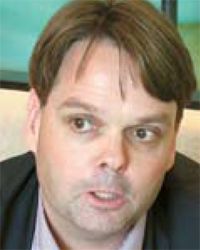
Ari Jan

Theo Hooghiemstra
By Chung Hyun-chae
Korea is one of the fastest-aging countries in the world, and the government has come up with various policies to solve problems which the aging population is expected to bring.
Education, if combined with business and the public sector, will help solve such problems. That is what the Living Lab, a Dutch government-led international education program, aims for, said the program directors.
The program invites universities, companies and public organizations of the Netherlands and other countries to develop practical solutions for real-life challenges, in the form of applied research. With the theme varying from country to country, the Living Lab set the theme of “smart aging” in Korea.
“Smart aging can be defined as improving the quality of life of people aged 50 and over in an aging society by using information and communications technologies (ICT) and producing better products, services and systems of both public and private sectors in the silver industry,” said Theo Hooghiemstra, a member of the board of directors of the EP-Nuffic.
EP-Nuffic is a Dutch organization for the internationalization in education.
“Aging is a contemporary societal challenge in both Korea and the Netherlands, which suits very well to be tackled in the Living Lab,” he added.
In the Netherlands, the number of people aged 65 and over was tallied at 3 million in 2015, accounting for 17.7 percent of the total population of 16.9 million, according to Statistics Netherlands.
The figure is even higher than that in Korea. The elderly took up 13.2 percent of the total population here in 2015, according to Statistics Korea.
As seen from those statistics, both countries should prepare for an aged society, where the ratio of senior citizens is 14 percent or higher.
“At the rate at which we’re going now, the costs of the healthcare system will reach 25 percent of the GNP in 2015, which is a big challenge to the Netherlands,” Hooghiemstra said. “We are in urgent need for innovation in health and welfare.”
Hooghiemstra and other directors signed a memorandum of understanding with Konkuk University and Samsung Medical Center to cooperate on this program during their visit between September and October. Under the accord, Konkuk University Medical Center and Classic 500, a retirement home run by the university, will take part in the program.
“Students from Korea and the Netherlands will conduct research at the university’s elderly care center with people working there,” said Ari Jan, another EP-Nuffic director.
Besides the research, the participating students can also take advantage of opportunities to develop their business ideas related to the aging of society.
Konkuk plans to recruit students and begin the program next March. The students will be trained by Dutch universities’ startup assistance centers on how to invest in and propel new business ideas about the aging society. Some students who show good performance will have opportunities to study in the Netherlands.
Four Dutch universities specializing in smart aging decided to participate in the Living Lab program. They are Windesheim University of Applied Sciences, Hanze University of Applied Sciences, Fontys University of Applied Sciences and HKU University of the Arts Utrecht.
These universities and Samsung Medical Center will have discussion sessions to cooperate on new business ideas about the aging of society.
“In the Living Lab, students do not just conduct research within the university but also in society, at companies and public organizations,” Jan said. “We want citizens to be involved in the students’ research activities so that the results of the research can benefit the whole society and increase the quality of life of the elderly.”
Applied research for real-life solution
The Netherlands has launched this program to encourage students to gain hands-on experience which can be helpful in finding better jobs and starting their own businesses. The Living Lab first started among Dutch universities but has expanded for joint research with schools in other countries to tackle social problems they commonly face.
The Living Lab was introduced in Korea in 2013 when the program was focusing on creative industries, specifically gaming.
Since then, POSTECH and HKU University of the Arts Utrecht have been working together to create games for improving physical health and promoting healthy activities. The students of the two schools gather every August to work on this project.
“Based on such success, we are to build a new Living Lab under the theme of smart aging this time,” Ari Jan said.
The Living Lab program has been introduced in four countries so far — Korea, Indonesia, Brazil and China — and each Living Lab has different themes.
Ari Jan has been involved in the program in Brazil which aimed to improve the production process of dairy companies.
Hooghiemstra expects the program to contribute to bringing the two countries together through networking.
“The Living Lab is providing a platform to learn from each other and to share our experiences and ideas on smart aging from both Dutch and Korean perspectives,” he said. “The Koreans can provide us with very high-level knowledge and expertise on ICT and other technology, whereas from the Dutch, we are quite strong in creativity and social innovation.”
Stressing that education and business are two sides of one coin, Hooghiemstra said international education is significantly important in doing business in an international context.
“For example, when a lot of foreign students who studied in the Netherlands go back to their home countries, they will have close relations with the Netherlands,” he said. “It is very good to have nurtured those who may do business with the Netherlands in the future.”
During their visit to Korea, the directors also met officials of Korea’s Ministry of Education to discuss the possibility of sending Korean students of vocational education, especially in agriculture, hospitality and tourism fields, to the Netherlands.
“This is quite new because student exchange programs have mainly been about exchange students in higher education only,” Hooghiemstra said. “More and more vocational students are also being internationalized.”