RASKB follows 'gentrification refugees' to Mullae

Young people walk past a corner store in Mullae-dong on Nov. 2. / Image by Jon Dunbar
By Jon Dunbar
Gentrification seems to be happening in every part of Seoul simultaneously. Some upgrading is always nice, but this also displaces communities of people and independent businesses. As these gentrification refugees move to new areas, they may carry with them the seeds of their own destruction.
The same is happening with Mullae-dong, a fading industrial region in southwestern Seoul where rents are low and facilities are unpleasant. As it is only four stops south of Hongik University Station on Line 2, artists fleeing Hongdae gentrification have been moving here since 2003. Even now-disgraced former President Park Geun-hye visited Mullae in 2014 to praise the “creative convergence” of the area.
Artists find inspiration in the stark industrial function of metalworks; during a visit on Nov. 2, two art displays were found made of repurposed rusted metal pieces from the shops.
Artist Kim Mio seeks to transform Mullae's transitory community into its own kind of urban forest through her
(forest) featuring woodcutting artwork.

Spider-Man hangs from a bush in an alley outside Mullae Soop (Forest) in Mullae-dong on Nov. 2. / Image by Jon Dunbar
The Hongdae exodus to Mullae expanded at the turn of the decade, as musicians abandoned former venues. Space Moon opened here in 2011, changing owners in 2016 and becoming GBN Live house. Lowrise opened here also in that time, later becoming Urban Art Guesthouse and now multipurpose space Warehouse D. Legendary punk club Skunk Hell reopened here in 2015. Mullae is especially attractive to musicians who play loud music, especially punk and metal. As the area already produces its own extreme noises, nobody has to worry about noise complaints from neighbors.
“We love Mullae and love that the metal bars/clubs are all right between metalworking shops,” said Michael O'Dwyer, co-producer of the
which he filmed with Ian Henderson over the past few years. “There are metal bands literally playing next to metalworking shops and small factories. It's really quite poetic!”

Members of foreign touring bands Pseudo (Canada) and Die Chiwawa Die and Struggle Session (China) pose in front of GBN Live House in Mullae-dong, Sept. 22, 2017. / Image by Jon Dunbar
This area traces its roots back to the 1930s when Korea was under Japanese occupation. In 1936, the capital annexed the area from Siheung County and built a major train station nearby, today's Yeongdeungpo Station. Mullae grew to host a textile industry, made possible by rail access and proximity to water. In the 1950s and 1960s, Mullae's main industrial output changed to metal. Quite a lot of the architecture here still dates back to the Japanese occupation, even if it hides under decades of dust and grime.
Today, two very different communities coexist in Mullae, unified only by the productiveness of their activities and their frugal budgets. Every time one of the aging machine shops closes, there's an art gallery, live music venue or boutique restaurant ready to take over. The area is starting to resemble the heavily gentrified Ikseon-dong of central Seoul. It is becoming hipsterish while still lacking franchises and fashion shops, but rents are rising. The already-established business owners of the area wring their hands, fearing they were just the first wave for the gentrifying forces they moved here to escape from in the first place.
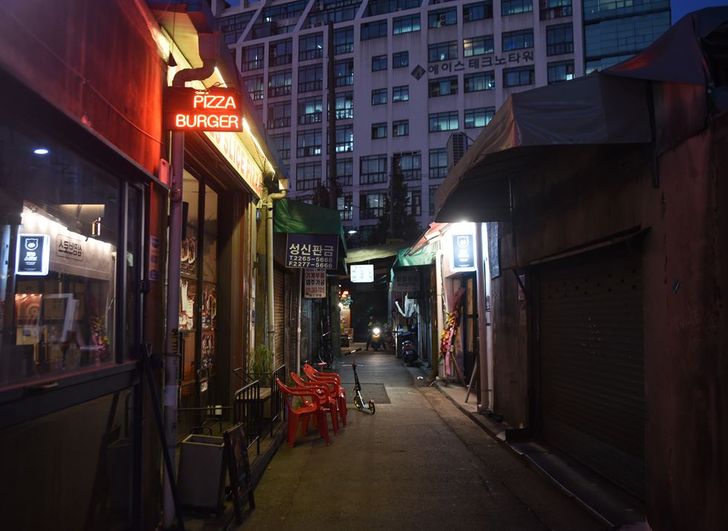
A McDelivery scooter brings hamburgers to workers in a machine shop, right down the alley from the fancy Yankees Burger in Mullae-dong on Nov. 2. / Image by Jon Dunbar/2018-11-06(코리아타임스)
The Royal Asiatic Society Korea Branch (RASKB), quite possibly the unlikeliest-sounding organization to take an interest in heavy metal, offers an afternoon excursion through Mullae this Saturday. “K-Pop Killers” director Henderson will walk with attendees through the neighborhood and introduce his film. Later, those who are brave enough are invited to join a hardcore-punk concert at GBN. The event costs 20,000 won for RASKB members and 25,000 won for nonmembers.
workspace-slash-gallery, Mullae Soop