All aboard! Traveling through Korea by train in the 1930s

The Seoul-Chemulpo railroad circa 1900.
By Robert Neff
In the mid-1930s, traveling by train through Korea was often, depending on who you were and what class you were traveling, romantic, adventurous and dangerous.
For the romantic side, we have the account of Audrey Harris, a British travel writer, who traveled by train from Antung (Dandong), a Chinese city on the Yalu River, to Seoul. She was very impressed with the service and wrote glowingly about it.
Her train, she explained, “was a Pullman with two polished metal washing basins, hot water and clean towels to each carriage, a curtain dividing their recess from publicity. The lavatory was separate and clean. There were holes at intervals in the carriage floors for fruit skins, nut shells and spitting ― much used.”
She was traveling in second class, so it was crammed with passengers ― mainly Japanese ― who took advantage of the cheap fares, but, fortunately for her, she had booked a sleeper berth.
Her accommodations were made even more comfortable with free toothbrushes, a clean cotton dressing gown and slippers. The attendant also brushed her clothing and polished her shoes brighter than she had ever seen them before ― at no extra charge.
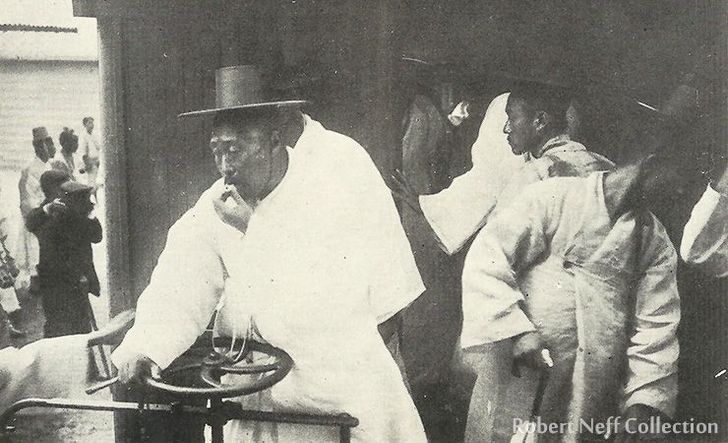
Passengers aboard the train circa 1900.
John Patric, on the other hand, was an American and traveling as inexpensively as he could to Seoul. In Fusan (now known as Busan), he had inadvertently boarded the express train instead of the regular train and wasn't aware of his mistake until much later. He wasn't the only one on his train having problems.
The train often stopped for a short time at small depots for water and fuel. During these stops the Japanese railroad police would inspect the train to ensure its continued safely and to discourage hobos from sneaking aboard, which appears to have been a fairly frequent occurrence. This time was no exception.
Beneath one of the coaches, the policemen discovered a small eleven-year-old boy clinging to the undercarriage with his fingers and toes. They immediately hauled him out and began beating him. Patric, whose youth was spent as a hobo (he hopped trains to travel about the United States and Mexico), felt an affinity for the boy and intervened by snatching him from the hands of the police and setting him free.
“On nimble bare feet, before the bewildered guards ― who never had that happen to them before ― could stop him, the boy” ran into the nearby scrub woods that lined the railroad tracks and disappeared. The guards were not pleased.
Once all the passengers were aboard, the train pulled out of the station and began to gain speed. Much to his horror, Patric spied the young boy dart from the trees and throw himself beneath the train.
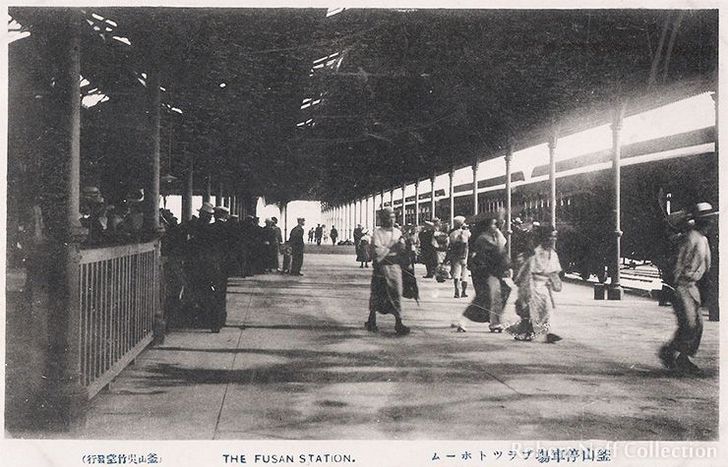
Fusan railway station circa 1920-1930s.
“At the next station I got off again, wrote Patric. “With an air of carelessness I bent down beside the railway coach to tie a shoelace I had deliberately untied beforehand, and stole a surreptitious glance toward one of the heavy, multi-wheeled trucks upon which rested the rear end of the car. There, on top of it, was the boy again, crouched cat-like, clinging with fingers and toes. I hoped the guards had not seen him attempt to resume the journey that seemed important to him.”
Unfortunately, they had. Four guards, two armed with revolvers and the other two with long heavy sticks ― “about six feet long, maybe an inch and a half in diameter, and one end of them had been whittled, like pencils, to sharp points” ― immediately set upon the boy. They poked him “savagely and roughly” with the sticks, drawing blood from several spots on his body, but “he was a brave lad, and stubborn” and managed to resist for “a surprisingly long time.” Eventually he fell from his perch and was led away, his hands and feet badly injured, while the guards continued to beat him. What became of his fate is unknown.
As for Patric, he refused to pay the difference in the fare (20 American cents) ― even when they threatened to jail him. When the Japanese stationmaster in Seoul became so frustrated with Patric that he agreed to let him slide on the fare adjustment, Patric surprised him by promptly paying. The frustration he had caused was his way avenging the brutality of the railroad police on the hapless Korean boy.