North Korea fires anti-ship cruise missiles
President convenes security council
By Jun Ji-hye
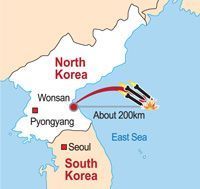
North Korea launched what were presumed to be anti-ship cruise missiles from its east coast Thursday morning, according to South Korea’s Joint Chiefs of Staff (JCS).
This is the North’s fifth missile firing since President Moon Jae-in was sworn in, May 10.
After receiving reports about the provocation from the JCS as well as national security adviser Chung Eui-yong, President Moon convened a meeting of the National Security Council (NSC) at 2 p.m. at Cheong Wa Dae to discuss countermeasures.
During the meeting, Moon made it clear that his government will never compromise on issues related to national security, presidential spokesman Park Soo-hyun said.
“North Korea will only face the deepening of its isolation and economic trouble should it stick to this provocative mode,” Moon was quoted as saying.
The President also vowed to enhance the country’s ability to defend against the North’s nuclear and missile threats while maintaining the ROK-U.S. combined defense readiness, according to Park.
Those who attended the meeting included Prime Minister Lee Nak-yon, Defense Minister Han Min-koo and National Intelligence Service director Suh Hoon as well as Chung.
The JCS said, “North Korea fired multiple unidentified projectiles, assumed to be short-range surface-to-ship cruise missiles, this morning from the vicinity of Wonsan, Gangwon Province, into the East Sea.”
Military authorities of South Korea and the United States detected the launch of the missiles at 6:18 a.m., the JCS said.
Army Col. Roh Jae-cheon, a spokesman for the JCS, told reporters later in the day that the missiles flew about 200 kilometers in a northeasterly direction from Wonsan at a maximum altitude of about 2 kilometers.
“We are currently conducting in-depth analysis to find out the exact number of missiles fired,” Roh said.
He noted that the latest provocation by Pyongyang was seen as an attempt to show off its different types of missiles. The launch also might have been aimed at displaying the regime’s ability to strike warships, as a U.S. Navy strike group recently conducted joint exercises with the ROK Navy in waters off the Korean Peninsula, he added.
Cruise missiles travel at low altitude and at slower speeds, compared to ballistic missiles, but are harder to detect by radar.
Kim Dong-yup, a professor at Kyungnam University’s Institute for Far East Studies, said the missiles fired were believed to be a new type of cruise missile that was displayed during a massive military parade conducted by the North to celebrate the 105th anniversary of the birth of its founder Kim Il-sung, April 15.
The latest provocation came after Pyongyang fired a Scud-type ballistic missile from Wonsan, May 29, which was later assessed as an anti-ship ballistic missile. At the time, the North claimed the missile featured a new high-precision guidance system and a faster launch process.
Earlier, the Kim Jong-un regime also fired an intermediate-range ballistic missile, May 14; a medium-range ballistic missile, May 21; and a surface-to-air missile, May 27.
Cheong Wa Dae said the NSC meeting presided over by President Moon was meaningful in that the government showed its firm attitude toward the North’s repeated and habitual provocations.
“The missiles fired today were cruise missiles, not ballistic ones. Cruise missiles can be seen as posing a greater threat to the people’s safety,” presidential spokesman Park said. “The NSC meeting chaired by the President took place to conduct in-depth discussions on how to deal with North Korea’s provocations fundamentally rather than repeating similar content in the previous government’s announcements.”
Foreign ministry spokesman Cho June-hyuck said in a separate media briefing that the government is fully prepared to respond firmly to the North’s military provocations and will keenly monitor the possibility of additional actions.