Moon's comments that colored presidential race

Moon Jae-in at a secretariat meeting in Cheong Wa Dae in June 2003. / Korea Times file
By Ko Dong-hwan
President-elect Moon Jae-in does not pull any punches when speaking in public.
The politician ― leading student protests against the Park Chung-hee regime’s decades-long dictatorship while studying law at Kyung Hee University in the 1970s and acting as a human-rights lawyer in his hometown Busan in the 1980s ― has been using his voice to move people’s hearts for altruistic causes.
His political efforts have earned supporters as much as they lured opponents. Consistently facing vertigo, Moon twice resorted to trekking in the Himalayas for self-reflection while serving the nation (in 2004, when he resigned from the Senior Presidential Secretary for Civil Affairs post, and in 2016, after the general election while advising the Democratic Party of Korea).
He declared he would leave Korean politics, only to return and mention “revolution” 97 times while encouraging citizens to join candlelit peace demonstrations calling for former President Park Geun-hye’s resignation and the Constitutional Court’s decision to impeach her, which eventuated.
Despite many controversies, Koreans have selected Moon to lead them. What motivated them to vote for him? It appears his words have given people hope amid growing national security issues and a struggling economy.
Here is a collection of Moon’s views on controversial issues.
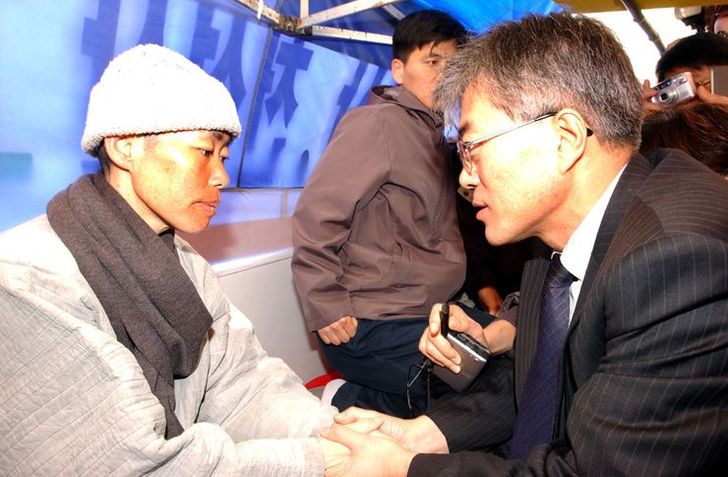
In this March 2003 photo, Moon Jae-in, serving as the Senior Presidential Secretary for Civil Affairs, persuades Buddhist nun Jiyul to stop her hunger strike in front of Busan City Hall. The nun was calling for the cancelation of a high-speed railway construction project through Mt. Geemjeong and Mt. Chunsung. / Korea Times file
North Korea
Moon, 64, said at the International Exposition Yeosu Korea in February:
“North Korea is a state of anomaly. We should come up with Pyongyang policies, minding the state’s unpredictable stance.”
The comment came following the death of Kim Jong-nam, the half-brother of North Korean leader Kim Jong-un, on Feb. 13, following an attack at Kuala Lumpur International Airport. Evidence showed that the reclusive state was behind the assassination, using a poisonous spray.
“If the assassination was politically motivated, I think it is a very cannibalistic act,”
Moon said.
Meeting farmers a few days later, Moon suggested trading South Korean rice for rare earths from the North.
“It will solve Pyongyang’s rice shortage and allow us to purchase rare minerals at a rate lower than the market,”
he said. But the foreign affairs ministry objected, saying this would infringe United Nations Security Council sanctions agreed to in March 2016 immediately after the North’s fourth nuclear test.
In an interview with The New York Times in March, Moon said he
“abhorred the ruthless dictatorial regime of North Korea.”
But he said the decade-long sanctions enforced by the U.S. and the South’s conservatives had failed to stop the North’s nuclear weapons program, suggesting it was time to try
“something less confrontational.”
“We must embrace the North Korean people as part of the Korean nation, and to do that, whether we like it or not, we must recognize Kim Jong-un as their ruler and as our dialogue partner,”
In a debate with philosopher Do-ol Kim Yong-ok, hosted by the JoongAng Ilbo in December, Moon said he will
“choose without hesitation North Korea over the U.S. to visit if I became the president. But I will explain the trip’s legitimacy to the U.S., Japan and China before going there.”
America
Moon’s intention to promote South Korean sovereignty in the face of American influences was raised in his New York Times interview, with an allegation that he said in his book that
“South Korea should learn to say ‘No’ to the Americans.”
Moon denied making the comment, but admitted having said when referring to former U.N. Secretary-General Ban Ki-moon:
“The South Korean envoy is too friendly with the U.S., he cannot object to the nation’s demands at all.”
Admitting the necessity of South Korea’s bilateral ties with the U.S., Moon called himself
“America’s friend” and said he was “grateful that the U.S. protected South Korea from communism and supported its economic growth and democratization.” He called the alliance with Washington “a pillar of our diplomacy.”
But he said South Korea’s appreciation
“should not represent a one-way relationship between the two nations.”
“The relationship should gradually become more constructive and mutually beneficial,”
he said.
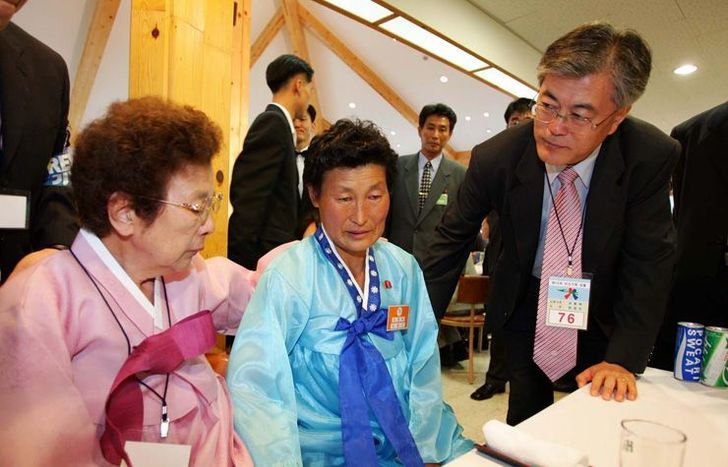
This July 2004 photo shows Moon Jae-in, serving as the Senior Presidential Secretary for Civil Society, and his North Korean defector mother Kang Han-ok, far left, talking to his aunt from North Korea at a Korean family reunion at Onjeonggak, a tourist complex on Mt. Geumgang. / Korea Times file
THAAD
Moon was not in a hurry to deploy a U.S. Terminal High Altitude Area Defense (THAAD) battery in South Korea to defend against possible missile attacks from the North.
“We should let the next government make decisions about that,”
Moon said in February.
“Holding on to that option will pose as an effective card when dealing with foreign affairs.”
He further criticized
“the impeached government hurriedly deciding to deploy the battery”
during a radio debate with the Democratic Party of Korea’s presidential nominees in March, referring to a vacant presidential office following Park’s ouster.
“It should be relayed to the next administration so that it could be reasonably solidified through the National Assembly’s ratification, plus the nation’s efforts on foreign affairs,”
But when Acting President and Prime Minister Hwang Kyo-ahn decided to start deploying the battery at a golf course in Seongju, North Gyeongsang Province, Moon questioned what had prompted the emergency administration’s move.
“It is hard to understand why the government is hurrying to install the weapon system,”
he said, adding that leaving the decision to the next administration will provide
“leverage in dealing in foreign affairs” and represents “our country’s best interest.”
Impeached former president
Moon was at the forefront of movements calling for former President Park Geun-hye’s removal on charges of corruption and demanding or accepting bribes during her presidency. As she defended herself by hiring lawyers and refusing to appear in court or face lawmaker questioning, Moon relentlessly called for her to step down.
“I warn Hwang,” he said on Facebook in February.
“If you prevent prosecutors from searching Cheong Wa Dae or extending the independent counsel’s investigation on Park, citizens will not be forgiving.”
He berated South Chungcheong Governor An Hee-jung the same month when An said Park had a “good will” when supporting the scandal-ridden Mir and K-Sports foundations. It was later revealed that Park’s long-time friend and accused influence-peddler Choi Soon-sil allegedly established the foundations to amass personal assets.
“There is no anger in An's remarks,” Moon said. “We can only establish justice based on fierce anger against injustice.”
Moon, in a February TV interview on MBN with his wife Kim Jung-sook, advised Park to
“stop squirming so hard to delay your impeachment” and “voluntarily sign out.” But he added, “her self-resignation should not be a subject of negotiation among politicians.”
While touting Park’s removal, petitioned in December’s parliamentary vote, he also urged people to accept the Constitutional Court’s decision on her impeachment case, even if the court denied the petition.