Book visualizes human rights violations in NK
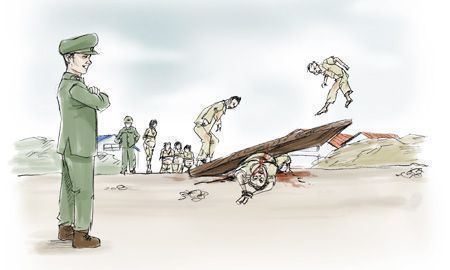
Prison officers in this drawing from a book on North Korea coerce prisoners to stamp heavily, or even jump, on a repatriated pregnant woman’s abdomen, thereby causing her body to abort the baby. / Courtesy of Kim Sang-hun
By Kim Se-jeong
Seeing is believing, and a picture is worth thousand words.
Visuals are what’s often missing when it comes to reports on human rights violation happening in North Korea, and the book “Eyewitness: A Litany of North Korean Crimes against Humanity” completes the story telling.
One image depicts two prisoners in a prison camp using a bleeding woman as a pivot for a seesaw. The caption explains this is one of the ways the authorities use to cause an abortion for a pregnant repatriated woman.
Startling and grievous hand-drawn images in the book are based on the testimony of former political prisoners.
According to Kim Sang-hun, chairman of the Database Center for North Korean Human Rights (NKDB) who was behind the publishing of the book, it took in-depth interviews with 14 former prisoners, general testimony from 81 and information accumulated by the NKDB.
“Artists made sketches while former prisoners were testifying,” Kim told The Korea Times. One artist was a North Korean defector who “had experienced the brutality firsthand.”
The book mainly focuses on what is happening in Chonko-ri Prison near Hoeryong in North Hamgyeong Province, where the most brutal and serious crimes against humanity are believed to be committed. All the people interviewed for the book were once imprisoned there.
“Chonko-ri prison was a life of hell, devoid of even elementary human feelings and language,” one former prisoner wrote. “If a prison officer called you from 100 meters away, you were expected to run immediately to him like a sprinter, kneel down and lower your head in front of him. Sometimes, guards would ask me a question I could not understand, and if I raised my head to ask for clarification I was immediately kicked in the face with a boot.”
Kim’s goal in this book is ambitious. “I expect North Korean authorities to react (to this book).” North Korea has never reacted to condemnations on human rights violations happening in the country.
That has really encouraged the international community to raise issues about it.
On Jan. 15, the United Nations High Commissioner for Human Rights Navi Pillay called for an independent investigation into North Korea’s human rights record.
“There were some initial hopes that the advent of a new leader might bring about some positive change in the human rights situation. But a year after Kim Jong-un became the country’s new supreme leader, we see almost no sign of improvement,” Pillay was quoted as saying by the Associated Press.
The book is available in English and Japanese.
Right now, copies are kept in Kim’s office, and he’s looking for ways to sell them in a large quantity to cover the print cost. He’s also in search of sponsors to start his second book project.
For those who’re interested in the book and his project, email him at
.