Moon commits to strong defense
Liberal candidate refutes allegations of UN vote on NK
By Kim Hyo-jin
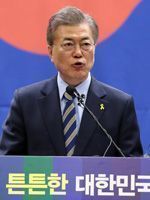
Moon Jae-in, presidential candidate of the Democratic Party of Korea
Moon Jae-in, presidential candidate of the Democratic Party of Korea (DPK), said Sunday he will prioritize increasing military strength and seek the early transfer of wartime operational control (OPCON) of South Korean forces from the U.S. to Seoul if elected.
As part of the nation’s efforts to defend against North Korea’s nuclear and missile provocations, the frontrunner vowed a strong commitment to national defense.
Moon apparently hopes to attract centrist voters in the lead-up to the May 9 election by allaying their worries about his liberal attitude toward the North.
The pledges come amid accusations calling him a North Korean sympathizer. He faces the allegations that when serving as presidential chief of staff for ex-President Roh Moo-hyun, Moon consulted with Pyongyang before the South abstained from a vote on a U.N. resolution on the North’s human rights abuse in 2007.
“I will never allow any military provocations by North Korea. I will prevent war based on thorough crisis management and a strong Korea-U.S. alliance,” he said during a press conference at the National Assembly. “I will put a priority on securing military capabilities to curb the North’s nuclear and missile threats.”
Moon pledged to speed up the deployment of the Kill Chain pre-emptive strike system and the Korean Air and Missile Defense (KAMD) plan, and improve independent surveillance and reconnaissance capabilities as part of such efforts.
He also promised to advance the timetable for OPCON transfer, which is scheduled to take place in the mid-2020s, although he did not specify an exact timeline.
While laying out plans for defense capabilities, the liberal candidate said he will take an active diplomatic approach with the U.S., China, and North Korea in dealing with the nuclear issue.
“I will persuade China to resume the six-party talks and the U.S. to improve its relations with the North, and North Korea to come to the negotiating table,” he said, stressing Seoul should take the initiative rather than relying on China.
The security pledges were unveiled as Moon has taken flak from rival presidential candidates and parties over a controversial abstention from a U.N. vote on North Korea’s human rights in 2007.
Their offensives gained steam after former Foreign Minister Song Min-soon disclosed a memo suggesting the Roh administration asked for Pyongyang’s opinion before it abstained from voting.
Moon’s camp responded sternly, saying it will file a complaint against Song with the National Election Commission for making a false allegation against him.
In an apparent bid to fend off the accusation, Moon’s spokesman Kim Kyoung-soo unveiled documents Sunday that showed the Roh administration had decided on the abstention independently.
In his memo written while he served as presidential secretary for speechwriting and documentation, Roh clearly said “This time we shall go for abstention” during a security meeting at Cheong Wa Dae on Nov. 16, 2007, indicating that the decision had already been made then.
It was supported by another memo by Park Sun-won, then presidential secretary for security strategy. According to the script, Baek Jong-chun, then chief presidential secretary for foreign and security policy, confirmed Roh’s abstention decision during a Nov. 18 meeting.
Song has argued the Roh administration had decided to abstain only after it received the North’s negative opinion on Nov. 20 over Seoul’s possible voting in favor of the human rights resolution.
The controversy continued during the third televised debate among presidential candidates Sunday evening.
Yoo Seong-min of the conservative Bareun Party repeatedly put Moon on the defensive, accusing him of having changed the details of his explanation.
“It’s an issue of integrity of someone who can possibly be a national leader. We have witnessed how many times Moon changed his words on the scandal,” he said.
Moon claimed in turn that Yoo’s attack is an old-fashioned tactic to smear liberal politicians by painting them as North Korea sympathizers.
“It is another version of the controversy over the Northern Limit Line. Then conservatives accused Roh of giving the NLL up to the North but later they were punished for making false accusations. It’s repeating again. I will not look on idly this time,” he said.