Royal night walk offers incredible palace views, cityscape

Visitors hold traditional lanterns called "cheongsachorong” as they walk in front of Injeongmun Gate of Changdeok Palace in Seoul, April 19. Newsis
Nighttime tours available at palaces in Seoul
By Kwak Yeon-soo
As Seoul loosens its social distancing rules, the city's royal palaces are resuming their special nighttime tours. Among them, Changdeok Palace is running a “moonlight tour” that offers not only incredible palace views but also night cityscapes. Guided by the delicate glow of “cheongsachorong” (traditional lanterns), visitors can enjoy a unique and unforgettable evening.
Changdeok Palace is one of the five grand palaces built during the 1392-1910 Joseon Kingdom. Built in 1405, it is the second royal residence following Gyeongbok Palace. It includes official affairs buildings, royal family residence buildings and the famous Huwon (Secret Garden) with a lotus pond and pavilions. UNESCO designated the palace as a World Cultural Heritage site in 1997.
The moonlight tour begins at the main gate of Donhwamun, where visitors can take a commemorative photo with a chief gatekeeper in traditional attire.
Then visitors cross the Geumcheon Bridge, the oldest extant bridge in Seoul originally built 1411, to look around Injeongjeon Hall, the main throne hall of Changdeok Palace and National Treasure No. 225, and Huijeongdang Hall, which was originally used as the king's sleeping quarters and was later used by the king as an office and reception hall.

Visitors look around Huijeongdang Hall of Changdeok Palace, which was unveiled to the public for the first time through the “Moonlight Tour.” It was originally used as the king's sleeping quarter and was later used as the royal office and reception hall. Newsis
Huijeongdang had gone through a series of destructions and reconstructions before it was burnt down in 1917. The present building was constructed in 1920 with the disassembled materials of Gangnyeongjeon Hall of Gyeongbok Palace.
“Huijeongdang Hall, which is unveiled to the public for the first time, retains a traditional exterior, but the interior (carpet, window, and chandelier) are Westernized. With the influx of Western civilization, a curved entrance was added to the building to provide easy access for the automobiles of King Sunjong (the last king of the Daehan Empire at the end of Joseon),” said Sung Hyun-hee, a tour guide who offered brief historical explanations.
Visitors move to Nakseonjae Hall, which was originally built in 1847 (the 13th year of the reign of King Heonjong of Joseon) as the king's quarter. It was a royal residence building, where King Gojong's only daughter Princess Deokhye and Japanese-born Crown Princess Yi Bang-ja lived until 1989.
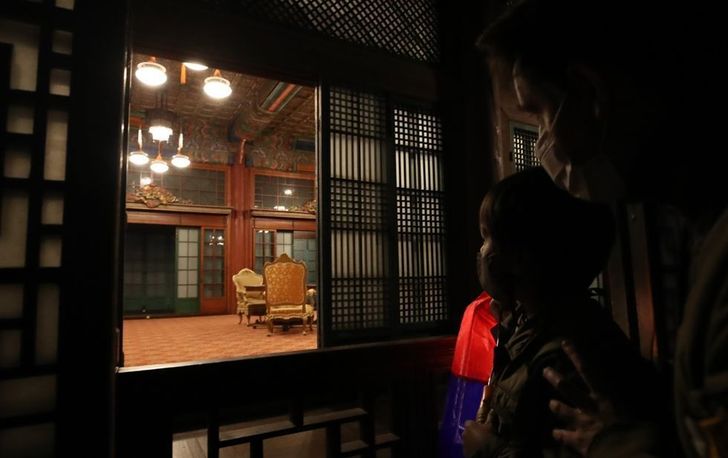
Visitors look around the Westernized interior of Huijeongdang Hall of Changdeok Palace, April 19. Newsis
“Unlike other buildings in Joseon royal palaces, Nakseonjae was built in accordance with the architectural style of aristocratic residences without using 'dancheong,' or multi-color paintings, on the building's surface. Also, the walls and fences were decorated with unique and various designs, which was not usually the case in other palace buildings,” she explained.
The tour continues to Sangnyangjeong Pavilion in the back garden of Nakseonjae Hall, which provides a panoramic nightscape view of Seoul. Visitors can enjoy the mood with a “daegeum” (large bamboo flute) performance.
Visitors walk past Buyongji Pond, where kings once took leisurely walks. “This area was the venue for celebratory banquets for scholars who passed state exams during the Joseon Kingdom,” Sung said.
On the northern side of the pond is Aeryeonjeong Pavilion, which offers beautiful views of the pond's scenery. Finally, visitors can enjoy traditional Korean refreshments at Yeongyeongdang Hall watching traditional dance and pansori performances. Korean tea and snacks are served throughout the tour.
Visitors will be led out by taking a stroll through Huwon Secret Garden.
The tours, hosted by the Korea Cultural Heritage Foundation, are available on Thursdays through Sundays and run through June 12. Each 100-minute tour accommodates 25 people with an entrance fee of 30,000 won ($24).

Visitors look around Geunjeongjeon Hall of Gyeongbok Palace in Seoul, April 1. Newsis
Besides Changdeok Palace, Gyeongbok Palace is also open for nighttime viewing through May 29 from Wednesdays to Sundays. Meanwhile, Gyeonghoeru, the largest two-story pavilion structure in Korea located inside Gyeongbok Palace, will be open for special tours until Oct. 31.
Deoksu Palace will run “Seokjojeon at Night,” an evening tour program that operates from May 3 to June 12. There are no evening tours on Mondays. At Seokjojeon, the first European-style building in the country that was used for diplomatic meetings during King Gojong's reign, visitors will get to enjoy “Gojong's tea time” with some snacks at the terrace cafe.