Father-and-son artists' cross-generational oeuvre explored

Joo Jae-hwan's "Portrait of Homin" (2020), left, and Joo Ho-min's "Portrait of Jaehwan" (2021) / Korea Times photo by Park Han-sol
By Park Han-sol
Upon entering the second floor of the Seoul Museum of Art (SeMA), visitors immediately lock eyes with the two amusing portraits on display side by side. A bright yellow face with flower-shaped sunglasses for eyes and a melting plastic ice cream for a nose fills the canvas on the left, while an elderly man's cartoonish face rests on an LED panel next to it.
“I didn't start out with the intention to draw my son's face but the yellow, round head ended up looking exactly like him,” the 81-year-old painter Joo Jae-hwan said of the portrait of his son, Ho-min.
Ho-min, the 40-year-old “webtoon” artist best known for his epic series “Along with the Gods” that explores the theme of mortality and the afterlife, had a different story to tell: “The fact that my dad's drawing accidently became my look-alike makes it much more fun. I, on the other hand, decided to draw him from the start and it just wound up looking dull and old.”
The quick-witted conversation between the father-and-son artists perfectly captures the unique sense of humor that runs in the Joo family and their works at the SeMA's new exhibition “Homin and Jaehwan.”
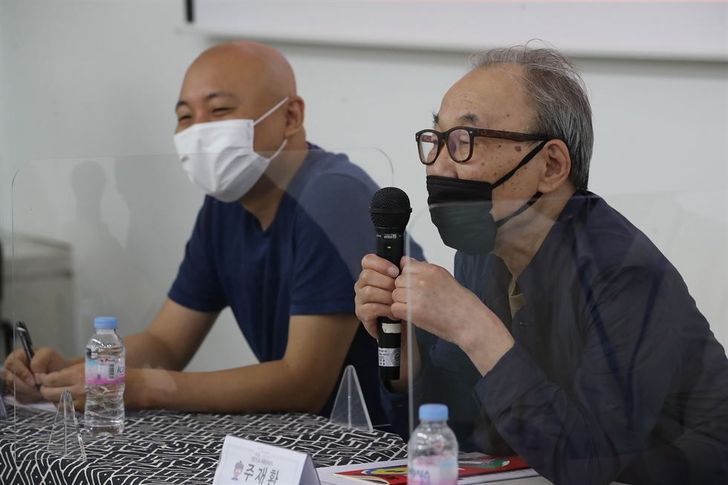
Joo Jae-hwan, right, speaks during a press conference held at the Seoul Museum of Art, May 17. Sitting next to him is his son, Joo Ho-min. Yonhap
By featuring the two seemingly disparate artists ― a painter who debuted in 1980 amidst political turmoil, and a web cartoonist who debuted in 2005 amid the rising unemployment rate and looming housing crisis ― the exhibition discovers much common ground present in their work, notably their focus on Korea's everyday reality, use of satire to expose social injustice and, finally, a knack for visual storytelling.
Although a majority of the two artists' works ― from Jae-hwan's creative use of everyday objects on a canvas to comment on social hierarchy, consumerism and even the hubristic art circle, to Ho-min's “webtoon” series including “Along with the Gods,” “Jjam” and “The Infinite Power” ― are displayed in separate sections, it is their works of organic collaboration, both direct and indirect, that prove to be the most interesting to witness.
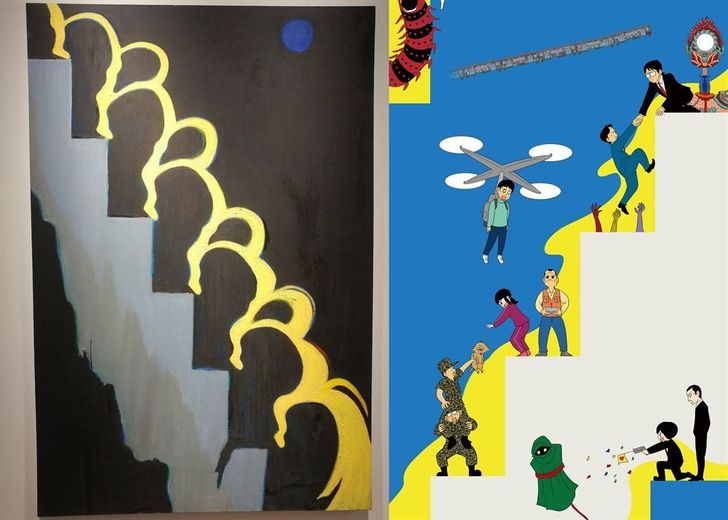
Joo Jae-hwan's "Spring Rain Descending a Staircase" (2010), left, and part of Joo Ho-min's "What Are They Doing down the Stairs?" (2021) / Korea Times photo by Park Han-sol and Courtesy of SeMA, respectively
Joo Jae-hwan's “Spring Rain Descending a Staircase” is a parody of Marcel Duchamp's “Nude Descending a Staircase, No.2.” Instead of attempting to capture the dynamic of the human body in continuous motion like the original, Joo adds a satirical touch and turns the staircase into a visualization of social hierarchy. The stream of yellow urine that starts flowing from the top grows stronger as it travels downward, affecting the bottom the most.
And in the exhibition, Ho-min presents the parody of his own father's iconic work, What Are They Doing down the Stairs?” Whereas Jae-hwan transformed the scene into symbols of a clear power imbalance, Ho-min turned the system upside down. Now, his characters seen from his “webtoon series” are helping each other climb the stairs in a spirit of solidarity.
Sometimes, Ho-min becomes an “ingredient” in Jae-hwan's creative process.
Jae-hwan's "Water versus The Illegitimate Children of Water” is an installation that consists of a set of clothes drying racks, filled with dangling bottles and cans of different beverages. By alluding to our present-day reality where fresh spring water has been replaced with processed drinks, it sends a critical message of worsening environmental pollution.
“I sent my son on errands to go to supermarkets and drugstores to buy the bottles of every kind. I needed empty ones, so by drinking most of them, he helped me create this work,” Joo said.
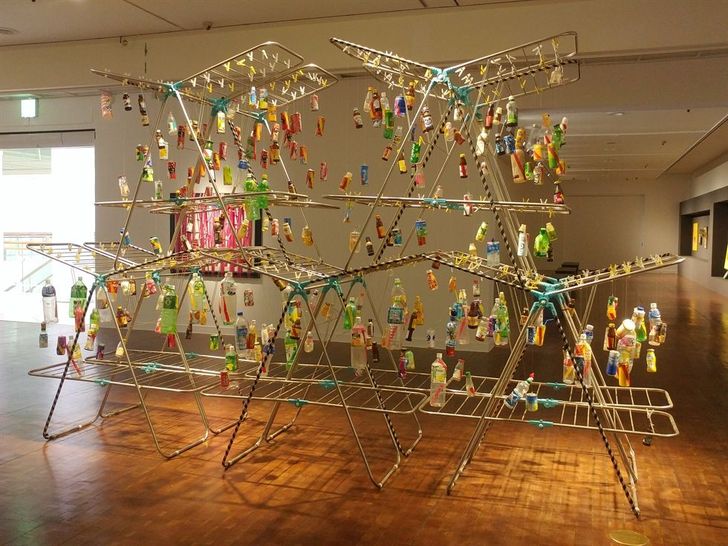
Joo Jae-hwan's "Water versus The Illegitimate Children of Water" (2005) / Korea Times photo by Park Han-sol
Another work “Shopping Man,” an outline of an individual composed of shopping bags that hints at our consumerist tendency, was also born with the help of Ho-min, this time with his own body lying on the bed as the model for the silhouette.
“Ho-min has been helping me bring my work to life, whether he knew it or not. He's a good son. I think this kind of connection led us to have a dual exhibition.”
Jae-hwan's presence becomes equally important in Ho-min's latest work. Ho-min, who has mastered the “webtoon” format, has been branching out to other digital platforms as a streamer on YouTube and Twitch. In one section of the exhibit, the clip that he recorded of them playing “Joo Jae-hwan World Cup” is on display.
Here, the “World Cup” refers to the popular game in Korea's entertainment scene, where an individual ranks their favorite subjects, whether they be actors, paintings, or movies, among 16 or 32 contenders presented in a tournament format.
In Joo's 15-minute clip, the father and the son discuss amusing stories behind 16 of Jae-hwan's paintings, each ending with Jae-hwan whimsically choosing the one he likes best, until they get to the winning image. The video demonstrates how Jae-hwan's traditional artwork can reach a new sector of the public as a completely different form of media, with the work of his digital guru son.
“We seem to be alike in how we can bring to life different ideas quite spontaneously. My mother also once commented that we both have the same postures when we draw or sleep,” Ho-min said, as he turned to face Jae-hwan, both being spitting images of each other.
The exhibition at SeMA runs through Aug. 1.
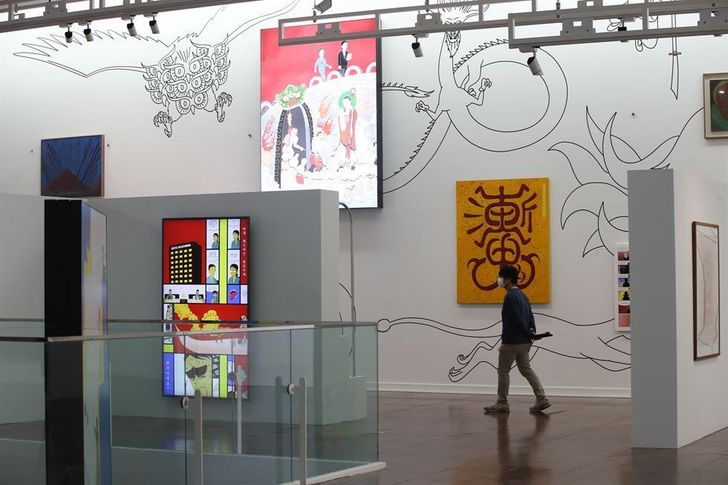
Installation view of the father-and-son artists' works displayed at "Homin and Jaehwan” at the Seoul Museum of Art / Yonhap