Pandemic has worsened ceramic artists' agony

Pandemic has worsened ceramic artists' agony
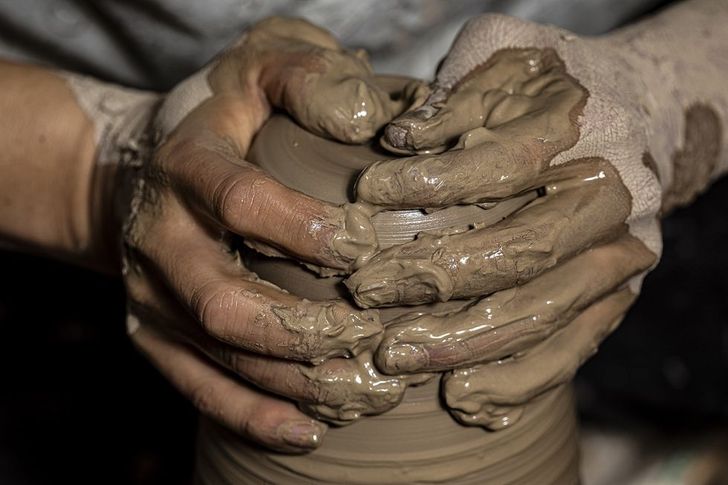
Ceramic artist Kim Hak-seung, founder of the ceramic studio Towoll, makes celadon at his studio in Sagimakgol Pottery Village in Icheon, Gyeonggi Province, on March 18. He and his wife Cho Jung-soon, not seen in this photo, have produced traditional wares of Goryeo Kingdom for the past three decades since he graduated from high school. Korea Times photo by Shim Hyun-chul
Self-employed artists in the town's pottery enclave were hit hard in the 1990s when Japanese binge shoppers stopped visiting. This time, they've been impacted by the COVID-19 pandemic.
By Kang Hyun-kyung
Icheon, Gyeonggi Province ― Self-employed ceramic artist Kim Hak-seung's eyes lit up when he caught a glimpse of some shoppers wandering “Sagimagkol,” a scenic pottery village in rural Icheon south of Seoul. Kim was peering through a window in his studio on the second floor of his building located at the mouth of the village.
“Look at them,” he said with excitement, pointing to two middle-aged women roaming down the street. “See? Each of them has a plastic bag. If tourists come here, they buy something. I'm telling you that tourism is the key to saving our businesses hit by the COVID-19 pandemic.”
Small groups of tourists were spotted here and there in the afternoon on March 18, but many of the back-to-back stores located along the street were still largely empty with almost no visitors inside.
The pandemic has dealt another blow to Icheon's ceramic artists, who have made traditional celadon and prunus vases for a living. Even before the pandemic, their business had waned as Japanese “binge shoppers” stopped visiting after their economy was mired in a decades-long recession.
Since last year, the COVID-19 pandemic has only worsened the agony felt by self-employed artists like Kim in the village.
The soft-spoken man didn't go into great detail about his pandemic-struck business, but said his heart had turned “as dark as soot,” a phrase Koreans use to describe the mental devastation brought on by hardship that shows few signs of ending soon.
Sagimakgol, which means a makeshift dwelling near a valley endowed with sandy soil, is packed with 55 back-to-back studios and shops. Due to its rich soil and fresh water, which are ideal for making pottery, Icheon City had attracted ceramic artisans from other parts of the country. Fascinated by its convenient location, some migrated deeper into the valley where the pottery village now sits.
Three groups of people are in business in the village_ traditional ceramic artists who make celadon and prunus vases; artists creating trendy, practical ceramic ware, such as kitchenware, cookware and other stylish daily products; and merchants who sell what others make.
Like Kim, some artists are self-employed, making their products in their studios and selling them in proprietary shops.
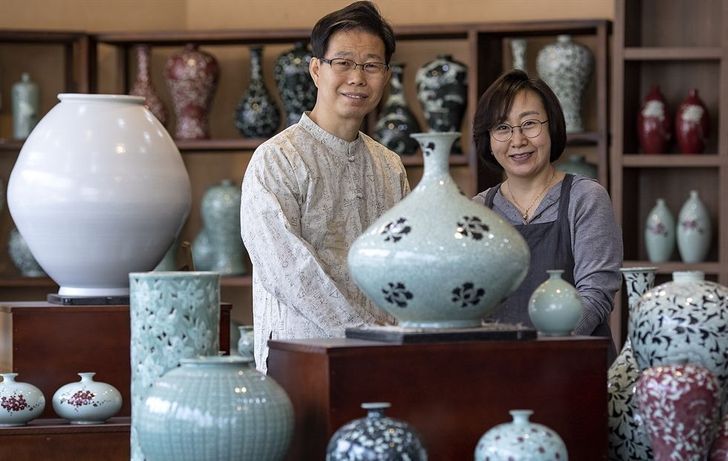
Ceramic artist Kim Hak-seung and his wife Cho Jung-soon pose at their shop on March 18. Korea Times photo by Shim Hyun-chul
For the past three decades, Kim and his wife have teamed up to produce celadon using traditional techniques dating back to the Goryeo Dynasty (918 A.D.-1392 A.D.).
What the Kims have gone through since last year following the outbreak of the coronavirus has been one of the worst periods they have ever experienced since opening their business.
Like other self-employed artists there, the couple has been enduring these tough times, crossing their fingers and hoping that the pandemic will pass so tourists can come back.
As a self-employed artist with his own studio and shop, Kim said his situation may be better than other ceramic artists and shop owners who pay rent to their landlords.
“Things will get better if tourists visit here again. People here are heavily dependent on tourism for a living,” he reiterated.
Thanks to his early start in the ceramic business, first as an apprentice for six years under an artist, and then as a professional, Kim was able to make enough money to buy his own building for his own studio and shop and send his two children to school.
In the 1980s, Kim said, being a self-employed ceramic artist was a lucrative job.
“Back then, this village was teeming with Japanese tourists. They loved Korean celadon,” he said. “Demand for celadon and prunus vases was explosive. We were unable to sell more because all our products were sold out as soon as they were made.”
During the heyday, Kim said, outsiders jokingly said even dogs in the pottery village carry 10,000 won bills in their mouths. Some people who were jealous of the thriving pottery business also said pets in this village were better treated than average people in other regions.
But the “good old days” seem to have passed.
The ceramic industry has been on a downward spiral since the 1990s. Kim said the turning point was Japan's so-called lost decade, which began in 1990 and pushed the Japanese economy deep into recession for nearly the next 20 years.
Japanese tourists stopped visiting, triggering the decline of the ceramic industry in Icheon. After the Japanese were gone, another group of foreigners began to visit the village.
According to Kim, many of them were U.S. soldiers and businesspeople who were about to leave after years of services and work in Korea.
“The Westerners became our new clients as they were looking for traditional artworks and something that could remind them of Korea after returning to their home country. Almost all of the Westerners were customers with purchasing power and they would pay if they found what they were looking for,” said Kim.
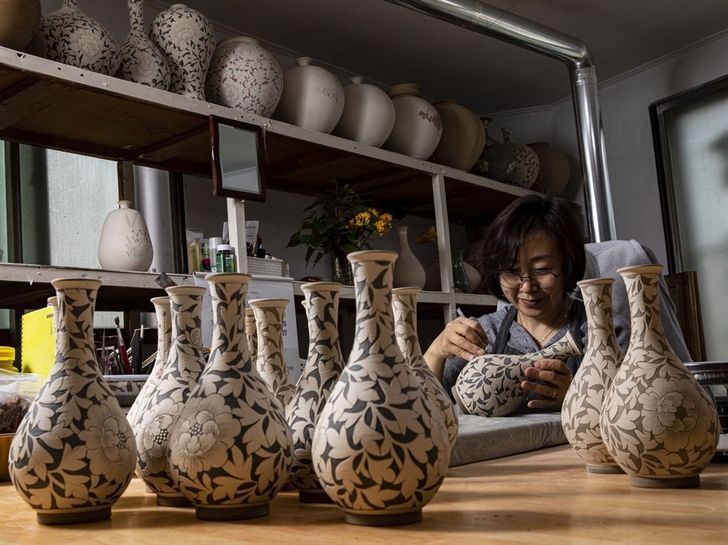
Cho Jung-soon decorates celadon her husband made. Korea Times photo by Shim Hyun-chul
The pandemic, however, kept even those customers away from the village.
Kim said his business now relies on loyal Korean customers in their 40s or older, a group of people he labelled as art aficionados who are willing to pay if they discover artworks that meet their high standards.
For sure, the pandemic has forced Kim to tighten his purse strings.
Before the virus outbreak, he earned a side income from golf trophies. From the early 2000s, he sold prunus vases and other ceramic ware to the organizers of KLPGA and LPGA tours held in Korea and other international sports events. Winners of the championships were awarded with prize money and ceramic ware as trophies with their names on them. Golfer Chae Na-yeon was presented with one of Kim's prunus vases when she clinched the KLPG tour championship. U.S. tennis star Venus Williams and Jeleva Ostapenko of Latvia are two of the tennis champions who received Kim's artworks as trophies. Along with the trophies, Kim also earned cash by selling mug cups or other ceramic souvenirs to the sports organizers who distributed them as gifts to other participants.
Since the pandemic began, Kim has been reeling from the cancellations of sports championships.
The situation facing tenants is even worse as it has become increasingly difficult to pay monthly rent.
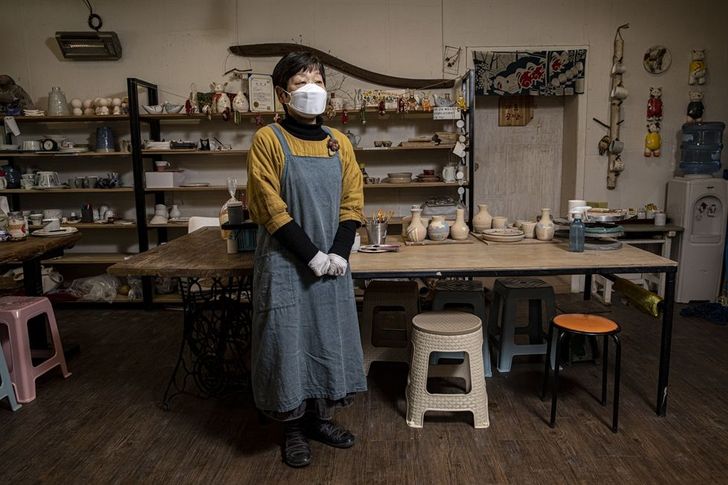
Yoo Joung-hee, who has running pottery classes for beginners for the past six years, looks out at her studio on March 18. Korea Times photo by Shim Hyun-chul
Yoo Joung-hee, who has been running pottery classes for beginners for the past six years with her newly-married daughter, Na-yoon, said the pandemic has forced her to spend her entire earnings just to cover the rent.
Although she is stretched, she tries to stay calm.
She said she has no plans to close down her business in the foreseeable future, partly because she still makes enough money to pay the rent.
Once the tough times pass, Yoo said she was hopeful that the pottery village may become crowded again. Her confidence is based on what she referred to as a “unique business ecosystem.”
“We, shop owners here, are benefitting from one another,” she said. “We're not competitors. I think the presence of dozens of shops and studios in the same cluster like this pottery village creates a sort of a win-win for the businesses operating here.”
According to Yoo, clients have different tastes and preferences when choosing ceramic ware.
“Each customer's preferred design and ceramic ware he or she is looking for are different from one another. Artworks and ceramic ware here are not products made from the same cookie cutter. Each studio produces its own, unique products, and diverse products with different functions are on sale here,” she said. “So, if one visitor doesn't find ceramic ware he or she is looking for at one store, they can move to the next one and then to the next shop until they find what they are looking for. This means each shop has its own customers.”
If there is only one shop and a certain customer doesn't find his or her products there, Yoo went on to say that they won't visit it again.
“But in this cluster packed with 55 shops selling very different products, people can find what they are looking for, because of the wide selections. Thus, they will visit here again. Here in this pottery village, the shops are interdependent.”
The shop owner used the same analogy when asked if she felt pressured by the presence of a newly-created pottery cluster, Ye's Park, on other side of Icheon City, as the new enclave became a popular venue for savvy travelers.
Yoo said she doesn't feel threatened by Ye's Park nor does she think her business will suffer.
“This pottery village has its own strength as a tourist attraction. It's small, but there are wide selections. So I think tourists will feel their visits to be worthwhile. The way stores are located in this village is another merit, because visitors don't need to spend much time looking around the entire cluster,” she said.

The front gate of Sagimakgol Pottery Village in Icheon City / Korea Times photo by Shim Hyun-chul
When times are tough, Icheon potters and city authorities help one another, instead of playing the blame game.
Last year, a city-wide campaign was launched to promote sales of locally-produced ceramic ware to help the financially-strapped artisans and ceramic ware merchants.
Taking place during the first two weeks of November, the voluntary initiative aimed for the dual goal of reducing plastic waste and promoting homegrown ceramic ware and pottery.
Under the scheme, citizens and visitors were encouraged to bring plastic kitchenware no longer in use to two designated places in return for prepaid coupons. Depending on the plastic products they brought, people were able to get up to 30,000 won worth of coupons, which they could use as payments to purchase ceramic ware in some 280 city-certified stores, including those in Sagimakgol.
It was the brainchild of Mayor Eam Tai-joon's tireless efforts to revitalize the local economy and reduce toxic waste at the same time by encouraging residents to use locally-produced ceramic ware.
The campaign drew positive reactions from the locals.
“It helped us find relief from the aftershock of the coronavirus. We're thankful for his efforts,” said Kim.