Joseon diplomat tired of interruptive China in 1880s

Lee Sang-jae (1850-1927), in left photo, served as the first secretary of the Korean Legation in Washington, D.C., from 1888 to 1889. He is one of the founding members of the Korean mission established in the United States. The right photo is Lee's book about funeral proceedings. The Cultural Heritage Administration (CHA) unveiled five documents and three old photos related to the Korea mission in the United States./ Courtesy of CHA
Old documents about Korean mission to US unveiled
By Kang Hyun-kyung
Over century-old documents display the struggle and immense pressure of the founding members of the Korean mission in the United States in the 1880s when sovereignty of their home country Joseon (1392-1910) was in peril amid power struggles among surrounding imperialist countries.
In a letter to his family written on April 13, 1888, Lee Sang-jae (1850-1927), then first secretary at the Korean Legation in Washington, D.C., which later became the Embassy of the Republic of Korea in the United States, revealed his determination to better represent his country.
“Diplomats from some 30 countries are posted in this country,” the letter reads. “They are from rich and powerful countries and our country Joseon is the poorest and weakest. But I won't give in to anybody. If I lose out in this deadly diplomatic battle, it will be shame on my country as well as our mission here.”
Assigned as first secretary in 1887, Lee, along with Minister Park Jeong-yang, headed to the United States in August to set up the legation. In the face of China which tried to exert influence on Joseon, Lee and other members stayed there less than a year.
The letter written on April 13, 1888, was one of 38 notes Lee wrote during his tenure at the legation.
The Joseon diplomat's letters were part of the five documents and three old photos that were made public on Wednesday.
The Cultural Heritage Administration (CHA) in collaboration with the Overseas Korean Cultural Heritage Foundation unveiled the historic documents. Lee's grandson donated the documents and other family heirlooms such as photos to the National Palace Museum of Korea.
The Overseas Korean Cultural Heritage Foundation acquired information about the existence of such documents while recovering the Korean Legation in Washington, D.C.
In another letter sent to his family, Lee, better known among Koreans by his pen name Wolnam, complained about the Chinese interference in the Korean mission.
In a letter written on Jan. 1, 1888, Lee wrote that an unnamed Chinese minister tried to find fault with the Korean mission in every issue and this put the Korean diplomats in trouble. The Chinese influence had drawn out his adjustment to the United States, he said.
In the 1880s, China's Qing Dynasty exerted a great deal of influence in Joseon's internal affairs. Joseon was able to send the diplomatic delegation to the United States for the establishment of the embryonic embassy there only after getting a nod from Qing. It was an approval with strings attached ― once Korean diplomats arrived in the United States, they were to pay a visit to the Chinese minister first and consult with their Chinese counterpart before meeting U.S. officials.
Lee was disturbed by the Chinese interference all throughout his time in the United States and later he and Minister Park met U.S. officials without reporting to the Chinese.
Han Cheol-ho, a professor at Dongguk University, said Lee's notes showed the diplomats tried to represent Joseon as a sovereign country and launched independent diplomacy in the United States without seeking China's prior approval. “The Koreans were under pressure all during their stay in the United States because of interruptive China,” the historian said.
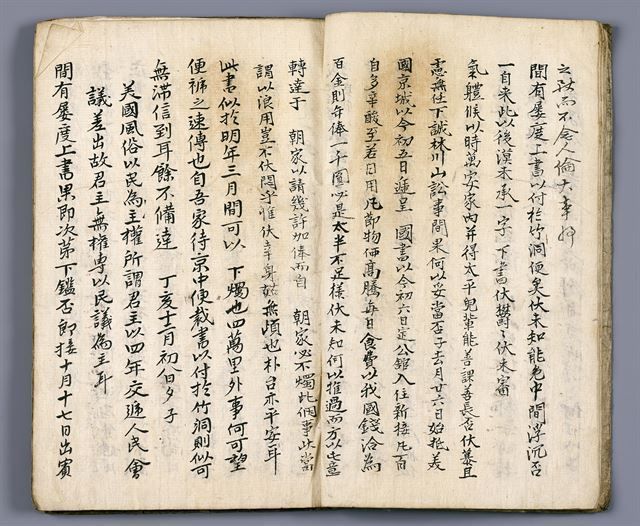
This photo shows a collection of Lee Sang-jae's 38 letters he sent to his family and friends during his tenure as first secretary at the Korea Legation in the United States. / Courtesy of CHA
Lee's notes show he was struggling with language barriers and culture shock and revealed his frustration over sharp differences between Joseon and the United States in every aspect from culture to political and legal systems.
Other documents include then U.S. President Chester Arthur's letter to send Lucius H. Foote to Joseon as the first U.S. envoy to Korea, Korean Ambassador Park's correspondence with U.S. officials and documents about the projects Korea and the United States had worked on together.
The Korean minister's handbook shows that Joseon and the U.S. government were in close cooperation to establish a U.S. company on the Korean Peninsula in charge of establishing railways, water pumps and a lighting project.
In the translated draft, a U.S. lawyer and three others propose the establishment of the U.S. corporation in Joseon to establish a railway to connect Seoul and ht port city of Incheon.
Regarding the U.S. proposal, Horace Newton Allen (1858-1932), a medical doctor and a Protestant missionary who was close to King Gojong, said the draft was well-written and all projects, except the lighting project, were feasible.
In a translated draft attached to the U.S. proposal, Allen said Joseon would benefit a lot if railway, gas and water pump projects get the nod from the Joseon government.
The American said railway and water pump projects were feasible but remained negative about the gas project, saying gas was way too expensive so few Koreans would opt for it. Allen commented the water pump project would help Joseon fight infectious diseases that were rampant at that time because of poor water sanitation.