Korea fights 'THAAD storm' over tourism
.jpg?w=728)
Only a few tourists are seen around Bukchon Hanok Village on March 20. It was one of the most popular areas for Chinese tourists in Seoul before the “THAAD shock.” / Yonhap
By Jung Min-ho
Korea’s central and regional governments are stepping up efforts to fight China’s attempts to throttle Korea’s tourism industry over the deployment of a U.S. anti-missile system here.
With more effort and better strategies, Korea’s government officials believe the country can turn the crisis into an opportunity and make the Chinese “retaliation” end in failure.
As part of its efforts, the government will allow Jeju-bound tour groups from Indonesia, Vietnam and the Philippines to travel to other parts of Korea without a visa for five days starting in May if they transfer at Incheon or Gimhae airports.
Tour groups from the three countries will also be eligible for electronic visas, which were previously allowed only for Chinese tourists. With the policy change, a group of five or more tourists will no longer have to visit the Korean Embassy in their country to apply for tourist visas.
The government will also help Korean airlines expand routes bound for Southeast Asia and develop partnerships with the region’s airlines.
In July, the Korea Tourism Organization (KTO) will open offices in Mongolia and Kazakhstan, which are expected to be important markets.
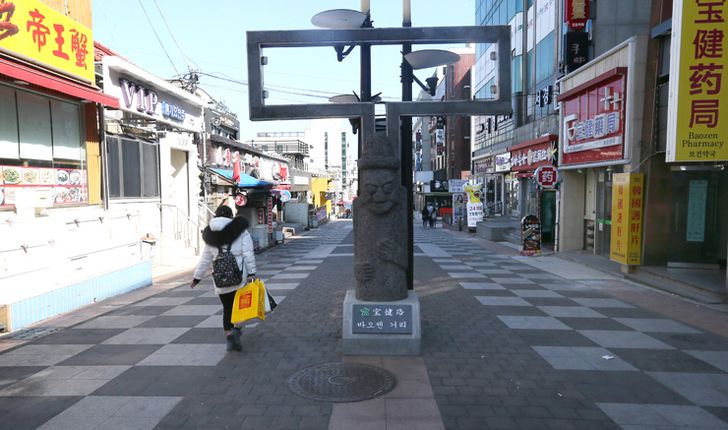
Empty Baozhen Street in Jeju City on March 4. The street, which was named after Baozhen Group, a Chinese company that sent 14,000 employees to the island as incentive travel in 2011, is usually packed with Chinese tourists. / Korea Times photo by Shin Sang-soon
The economic fallout from the anti-missile Terminal High Altitude Area Defense (THAAD) has increasingly become serious and may still get worse.
According to the Ministry of Culture, Sports and Tourism, the number of visitors from China between March 1 and 19 decreased 21.9 percent to 280,000 from 360,000 during the same period last year.
The shock came after the China National Tourism Administration ordered travel agencies to suspend organizing group and individual trips to Korea in protest over THAAD.
For the businesses affected by the retaliation, the Ministry of Strategy and Finance will set aside 225 billion won ($200 billion) in special loans and guarantees to help them.
Minister Yoo Il-ho vowed to reform the industry, which he reckons relies too much on China, even if it takes great pains to do so.
.jpg?w=728)
No lines are seen at Incheon Port International Ferry Terminal 1 on March 15. According to industry sources, about 20 travel guides are usually around there for Chinese tourists. / Yonhap
Regional governments have been making their own efforts to fight “THAAD storm.”
The Seoul Metropolitan Government recently decided to offer more language services _ Thai, Vietnamese and Malay _ to information boards in its popular areas, including Itaewon, Dongdaemun Market, Bukchon Hanok Village and around Hongik University.
The city government successfully hosted a tourism road show in New Delhi earlier this week to attract Indian business and individual travelers.
The Busan Tourism Organization (BTO) plans to shift its target from Chinese tourists to those living in other Asian regions, including Taiwan and Japan. It has already allocated 1.45 billion won to promote the city as a destination for meetings, incentives, conferences and exhibitions (MICE), which is more than double last year’s budget. The BTO will also put more effort into promotions for local tourism.
Despite all these efforts, some economic losses may be inevitable in the near future. According to the Korea Tourism Organization, 8.06 million Chinese tourists visited Korea last year, which accounted for nearly half of the 17.2 million tourists. On average, they spent $2,391 per person.
Based on that figure, some experts estimate Korea could suffer a sharp drop in tourism revenue by $9.63 billion, should it lose half of its Chinese tourists.