Gov't to expand tax benefits for reshoring

By Yi Whan-woo
The government will extend the duration of a tax break for Korean companies that bring their overseas production back home to 10 years from the current seven in a bid to facilitate investment and spur the ailing economy.
It will also provide bigger tax breaks for a range of foreign workers who are increasingly prevalent in Korea's workforce amid a rapid population decline.
The period of a 50 percent tax cut on income for skilled engineers and scientists from overseas will be extended to 2028. For employees hired at small- and medium-sized enterprises (SMEs), a 70 percent tax cut on income will be extended to 2026.
Announced by the Ministry of Economy and Finance, Thursday, these measures are part of the tax code revision proposed by the Yoon Suk Yeol administration that is struggling to cope with a massive shortage in tax revenue.
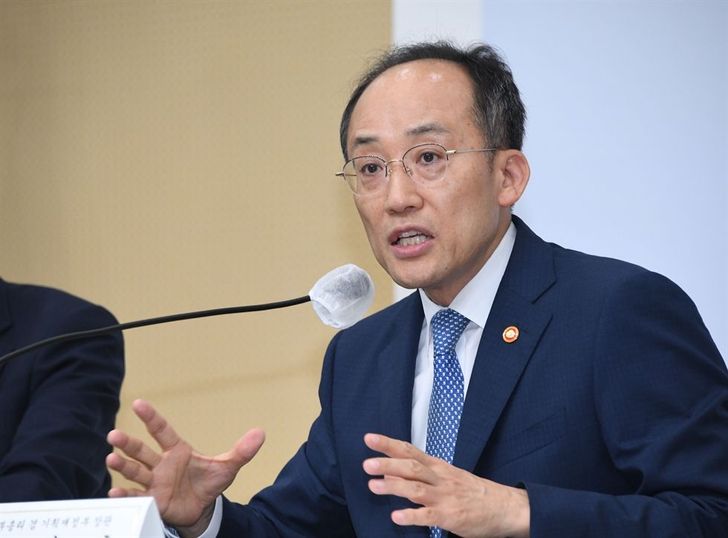
Deputy Prime Minister and Minister of Economy and Finance Choo Kyung-ho speaks at a preliminary press briefing on the tax reform plan at the Government Complex in Sejong City, Monday. Courtesy of Ministry of Economy and Finance
In a preliminary press briefing before announcing the tax reform plan, Deputy Prime Minister and Minister of Economy and Finance Choo Kyung-ho said the plan will serve the government's goal of easing the tax burden for businesses and investors.
“The government remains unchanged in lessening the tax burden at a time of economic hardship and we wanted to ensure spending and investment for households and firms through this year's revised tax rules,” he said.
He called the 2023 tax code revision “well-balanced” in securing taxable income, amid concerns that it is far behind in the tax collection schedule for this year. The government collected 36.4 trillion won ($27.6 billion) less in tax between January and May compared to a year earlier.
The tax reform plan is divided into four main goals ― revitalizing the economy, stabilizing the people's livelihoods, countering demographic changes preemptively and colleting tax in a fair and objective manner.
On its path to enliven the economy, the government seems to be capitalizing on the global popularity of Korean movies, dramas and other visual content by softening the tax burden.
It said it will expand the rate of tax deduction for content production to a range of 15 percent to 30 percent, up from current range of 10 percent to 15 percent, depending on the size of the producers, including conglomerates and SMEs.
To stabilize the people's livelihoods, the government will offer tax refunds for those who are repaying interest on housing loans if their home is worth less than 600 million won. Under the current rules, only borrowers whose homes are worth less than 500 million won are eligible for the tax benefit.
Depending on the repayment method, the amount of tax return per year will be hiked as high as 20 million won, up from 18 million won.
To encourage marriage and births, newlywed couples will be exempted from gift taxes for up to 100 million won in cash, as compared to the current 50 million won, received from parents.
For parents with a child aged 6 or younger, a 15 percent cap on tax credit for medical expenses will be scrapped.
The government will tighten monitoring on wealthy individuals who have overseas assets and have them managed by a trustee to prevent tax evasion.
The executive and rank-and-file members at the Korean office of an international company will be asked to submit relevant files on stocks and other cashable bonuses they receive from the parent firm.