Korea Customs Week anticipated to bolster favorable environment for exporters

Customs commissioners from participating countries attend a roundtable presided over by Korea Customs Service (KCS) Commissioner Yoon Tae-sik on the opening day of Korea Customs Week 2023 at The Shilla Seoul hotel in central Seoul, Wednesday. Yonhap
Seoul declaration adopted to bolster administrative cooperation, digitalization
By Yi Whan-woo
Korea hopes to foster a favorable trade environment for exporters through Korea Customs Week 2023, a three-day international gathering in Seoul that discusses ways to lower tariff barriers, the chief of the country's customs regulatory body said Wednesday.
Korea Customs Service (KCS) Commissioner Yoon Tae-sik also said the Seoul event could hopefully contribute to consolidating multilateral cooperation against drug trafficking and smuggling of firearms as well as other prohibited goods across the borders.
“The main purpose of Korea Customs Week 2023 is to create a friendly business environment overseas for our export-oriented companies here amid growing protectionism and foreign policy prioritizing self-interests of individual countries,” Yoon said during a press conference to mark the opening of the gathering at The Shilla Seoul hotel in central Seoul.
Hosted by the KCS, the Seoul event is running through Friday with the participation of more than 600 customs administers and experts from 78 countries.
The KCS has organized the meeting for the first time, to strike “a delicate balance” between legitimate trade and border protection against illegal goods under a broader goal of deepening administrative collaboration and digitalization of customs clearance systems.
The meeting is themed “Challenges and Tasks for Digital Customs and Global Customs Cooperation,” consisting of a roundtable, eight seminars, briefings on customs administration-related technologies, bilateral and multilateral dialogues among customs commissioners, business meetings and a field trip.
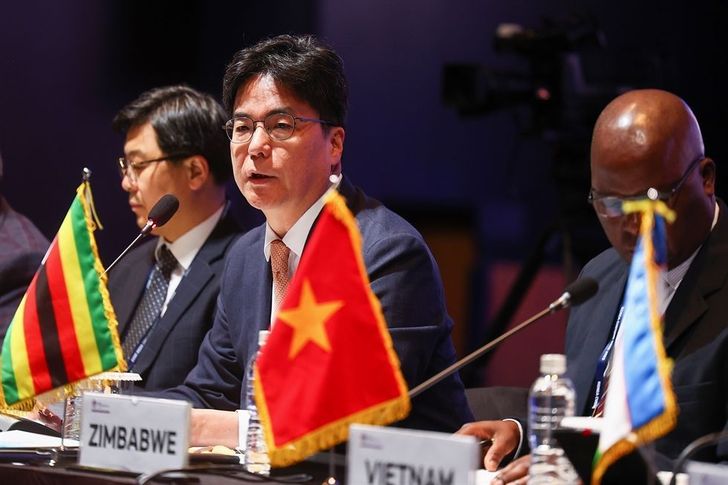
Korea Customs Service (KCS) Commissioner Yoon Tae-sik, center, speaks as he presides over a roundtable on the opening day of Korea Customs Week 2023 at The Shilla Seoul hotel in central Seoul, Wednesday. Yonhap
The KCS chief highlighted the need to lower tariff barriers among the six areas of shared interest addressed in the so-called “Seoul Declaration.”
The six areas are; the facilitation of cross-border movements of goods by enhancing customs clearance systems and simplifying customs procedures; collaboration to expedite the digitalization of customs by integrating innovative technologies; cooperation in technical assistance and capacity building to ensure efficient customs administration; exchange of information and data among customs administrations for fair trade; establishment of consistent and harmonized practices concerning cross-border trade issues; and multi-layered cooperation among international organizations, border agencies and the private sector to enhance the efficiency of customs administration and improve the overall business environment.
The declaration was announced during the roundtable presided over by Yoon earlier in the opening day, with a consensus among customs commissioners from 56 out of 78 countries.
Concerning drugs, Yoon said representatives from 18 Asia-Pacific countries agreed on another joint declaration to facilitate the exchange of human resources and information on the crackdown of narcotics.
The Asia-Pacific region accounted for 76 percent of drug smuggling cases in Korea last year, according to Yoon.
“Taking this into account, the joint declaration among the 18 countries will be significant in fully banning the smuggling of narcotics into the country,” the KCS chief said.
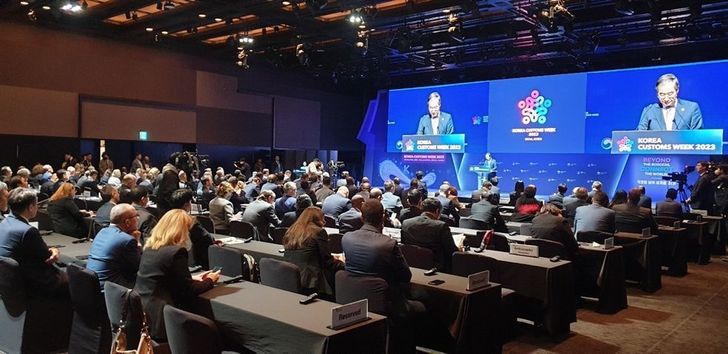
International participants listen to Prime Minister Han Duck-soo delivering a speech during the opening ceremony of Korea Customs Week 2023 at The Shilla Seoul hotel in central Seoul, Wednesday. Korea Times photo by Yi Whan-woo
In his separate message during the opening ceremony, Yoon underscored a need to share knowledge, experience and know-how among the countries to “minimize trial and error” on customs administration and create synergy.
The ceremony was attended by Prime Minister Han Duck-soo, who urged the participants to have an in-depth discussion to bolster cooperation by countries and by regions.
He also called for transparency, saying it “leads to greater predictability in trade, resulting in increased trade volume.”
“It also minimizes the potential for corruption and encourages compliance with regulatory standards. Above all, it helps identify and dismantle many invisible trade barriers that could otherwise undermine seamless trade flow,” he added.
The prime minister accordingly expressed hope that artificial intelligence, big data and other up-to-date technologies will “significantly improve transparency and overall efficiency of customs administration.”
For advanced countries, he asked to continue to seek a better approach to collaborate with developing countries to enhance their customs administration.
Han viewed that Korea especially “illustrates that enhancing customs service systems is crucial for a country's economic growth, as it promotes trade and boosts the overall utility of the national economy.”