Gov't unveils W24 tril. projects for regional economies

Finance Minister Hong Nam-ki announces plans to develop 23 infrastructure projects at a press conference in Sejong City, Tuesday. Yonhap
Big spending will increase tax burden in long run, analysts say
By Park Hyong-ki
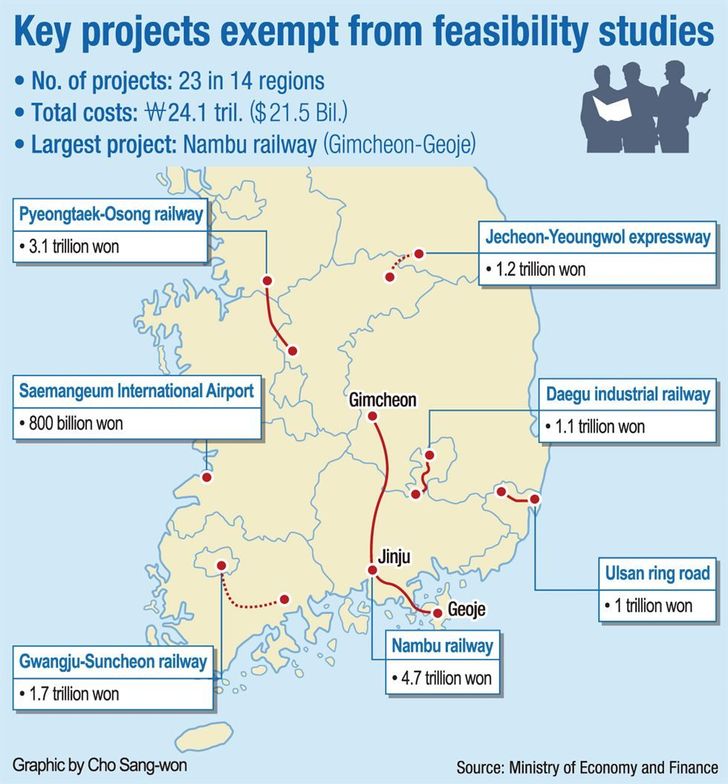
The government will spend over 24.1 trillion won ($21.5 billion) to develop highways, ports, airports and industrial centers nationwide to create jobs and revitalize regional economies, according to the Ministry of Economy and Finance, Tuesday.
Finance Minister Hong Nam-ki said his ministry will pursue projects that will rebuild provincial regions facing not only a slowdown but also deteriorating infrastructure.
The Cabinet endorsed the plan for 23 regional projects, which do not have to go through feasibility studies prior to their initiation. Some of the key projects include a 4.7 trillion won railway connecting Gimcheon, Jinju and Geoje Island in the south, and a 1 trillion won expressway in Ulsan.
It also approved a plan to raise 175 trillion won to spend on other regional economies by 2022 to spur growth. Of this, the government will seek private sector funding of 19.8 trillion won.
This plan includes building education, welfare, healthcare and culture and arts facilities in regions whose economies are dependent on fishing and farming, and where the aging population is growing rapidly.
Overall, the government is seeking to modernize the country beyond Seoul and Gyeonggi Province, which were left out of state-led regional development plans.
“The country faces a vicious cycle in which the young are leaving regions because of poor infrastructure. Also, those regions face difficulties in pursuing projects because they cannot pass feasibility studies,” Hong said at a press conference in the administrative city of Sejong.
“Before the income gap between Seoul and those regions worsens, we need to develop them for balanced growth.”
Hong added the government is expected to spend nearly 2 trillion won on average a year over the next decade on the 23 projects.
At the same time, it will efficiently manage its finances.
The finance minister insisted that spending on the projects would not burden the economy, considering the budget for 2019 is 470 trillion won, and they are nothing like the Four Rivers Restoration Project initiated by the 2008-13 Lee Myung-bak government.
However, analysts beg to differ, saying projects exempted from feasibility studies are more likely to increase the risk of burdening the public in the end.
Feasibility studies are conducted to analyze and forecast demand for infrastructure use prior to its development to reduce risks and unnecessary future costs.
Without them, the projects only increase the burden on the taxpayer in the long run, even if they boost growth in the short term, they said.
“The government should not pursue all of them, but only ones with definite economic viability that can help rebuild certain regions hit by natural disasters,” said Yun Chang-hyun, an economist at the University of Seoul.
“If some of these projects do not have a demand, then it will cost more to manage them later on. That will come out of the people's pockets.”
The People's Solidarity for Participatory Democracy also urged the government to reconsider its plan that could cost the next generation a huge amount of money.
The civic group compared the government's plan to that of the former Lee administration, which sought to revive the economy through construction projects.
It added the government should refrain from reviving the economy through such projects, which already account for 15 percent of economic output, higher than the OECD average of 10 percent.
“Pouring massive amounts of taxpayers' money into construction will not help Korea regain its industrial competitiveness,” the civic group said in a press statement.
It suggested it was more imperative to pursue industrial reform and develop a sustainable welfare system with the aim of creating jobs for low- and middle-income earners.