Economy faces steep downturn
Industrial output posts biggest drop since March 2013
By Park Hyong-ki
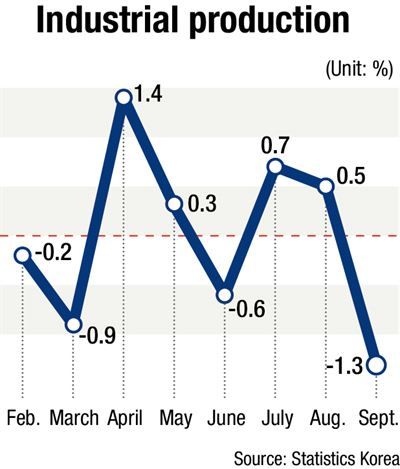
The country's industrial production fell 1.3 percent in September from the month before, according to Statistics Korea, Wednesday.
This marks the biggest decline in five years and six months, further backing warnings by Finance Minister Kim Dong-yeon, who said the economy is in a “difficult situation.” The minister added he does not expect the economy to get better in the short term even if its state-owned companies increase hiring of temporary workers and interns.
As the statistical agency announced weak data for retail and car sales, as well as other indices measuring the current and future economic conditions, it, too, said it would be “hard not to say the economy is in bad shape.”
Retail sales dropped 2.2 percent in the same period, the biggest drop since December 2017. Car sales decreased 12.4 percent, the steepest fall in 20 months despite lowered consumption taxes.
Falling consumption ― in part due to the sluggish job market ― has weakened demand for manufacturers to boost production, leading to an overall output slide, analysts say.
The only thing that actually rebounded “slightly” was private investment for plant expansion, mostly thanks to SK hynix's mega plan to increase chip capacity. To this end, facility investment increased 2.9 percent, after falling for six consecutive months.
Analysts agreed the economy is in “bad shape,” pointing to indices such as the coincident indicator, which measures the current economic condition. It has been sliding for six straight months.
However, they added Korea is “not yet” in crisis, but on its way toward a contraction.
“Technically speaking, the economy is facing a slowdown, which can potentially end up in a recession,” said Lee Sang-jae, an economist at Eugene Investment & Securities.
“Things are not looking good in 2019 due to the ongoing trade dispute between the United States and China. Also, the U.S. economy could slow down a bit after hitting its peak in 2018.”
Korea's exports driven by semiconductors have been the only good news for the economy. However, the analyst added the question remained as to how long chips can back Asia's fourth-largest economy when there are no signs of the trade conflict abating soon.
China is also pushing to boost its self-sufficiency of semiconductor production, while the U.S. is restricting imports of and cross-border partnerships in developing high-tech goods, analysts say.
Yun Chang-hyun, an economist at the University of Seoul, agreed the economy is not in crisis, but “signs of it brewing are everywhere.”
“It is in serious condition, which calls for a policy overhaul,” Yun, said, indicating the failure of the government's policy that only promotes labor while not even considering boosting private sector innovation and productivity.