Moon faces growing criticism over economy

President Moon Jae-in holds a Cabinet meeting, Oct. 23. The President is coming under criticism for his lack of interest in the economy. Yonhap
Kim, Jang's fates hang in balance amid signs of crisis
By Park Hyong-ki
President Moon Jae-in and his economic team are increasingly coming under criticism for his alleged lack of interest in saving the economy while being fixated on reconciling with North Korea.
His nonchalance is making room for more rumors and demands that Finance Minister Kim Dong-yeon and presidential chief policy adviser Jang Ha-sung can't work together. To this end, they are likely to be replaced at the end of 2018, something Cheong Wa Dae denied.
Or else, analysts say the economy will become worse in 2019 as a crisis is brewing amid the onslaught of weak data, including the composite leading indicator (CLI). The CLI, which measures the future of an economic cycle over the next six to nine months, has declined for 17 consecutive months.
“The Moon administration needs to change his team and give full responsibility to a single person who can make decisions and carry out policies after taking into account all factors such as business and labor,” said Yun Chang-hyun, an economist at the University of Seoul.
“This should be done as the first step toward restoring confidence amid warning signs of an impending crisis. Otherwise, the economy will be in deeper trouble in 2019.”
Some lawmakers including Rep. Yoo Seong-min of the Bareunmirae Party in the latest National Assembly audit have criticized the President for “ruining” the economy.
Yoo said the President's advisers are “arrogant,” being “blinded by self-righteous” over his labor-only policy, even though data have clearly shown it has put many of the self-employed out of business and destroyed jobs. Yoo has also criticized the administration for tampering with the central bank's independence over its rate policy.
Yun agreed with Yoo, who also stressed it is time for the people to raise and show their “red cards” to the administration as in a soccer match when a player commits a serious offense.
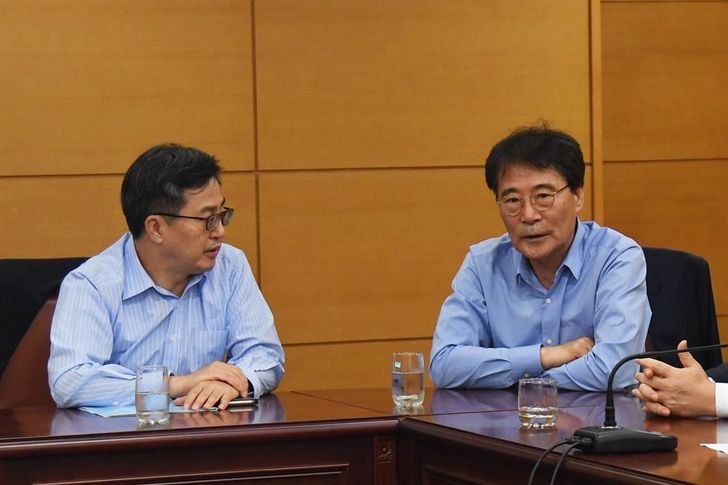
Finance Minister Kim Dong-yeon, left, and Jang Ha-sung, President Moon's chief policy adviser, hold discussions on the economy at the Financial Supervisory Service's training center, Aug. 29. Courtesy of Ministry of Economy and Finance
The President has been facing growing criticism amid reports that he has received only “one” briefing on the economy from the finance minister since January 2018.
Cheong Wa Dae spokesman Kim Eui-kyeom said Oct. 26 that this was not true, adding Finance Minister Kim has briefed the President 13 times on a variety of subjects ranging from budget and real estate to household income and jobs. Kim did so during Cabinet meetings that have been held 96 times from January to Oct. 12.
But he did admit to reporters that it has been difficult for the President to squeeze in his time to hear about the economy due to his busy schedule in going over national security and diplomacy concerning North Korea.
Nevertheless, the President talks with his advisers, including senior secretary for economic affairs Yoon Jong-won, in a meeting every day, the spokesman added.
Cheong Wa Dae recently disclosed the content and the number of President Moon's closed-door meetings, which led to criticism that his only interest and top priority was North Korea.
This is one of reasons the President should give “full authority” to a single person who can tackle future economic challenges such as reforming the market given his lack of interest in it, Yun added.
Analysts say the poor economy driven by misdirected and bad policies will negatively affect the ruling party and the administration at the national elections in 2020.
“The failure of key economic policies would cost the government ahead of the 2020 elections as voters are more concerned about their livelihoods,” said Park So-yeon, an analyst at Korea Investment & Securities.
The analyst added that even its innovation policy “lacks details,” pointing to the government's economic plan for the second half of 2018, which was unveiled in July and included broad information about what it needs to do to develop human resources for the new digital age.
Yun also pointed out that the government's plan for job creation unveiled Oct. 24 omitted one of key logical reasons behind the country's job crisis ― the rapid hike in the minimum wage.
He added this is probably what Rep. Yoo meant when he said the administration was “blind and arrogant” because the government will still not admit its one-sided policy has failed and change it.
The Bank of Korea (BOK) projected the country will only create 90,000 jobs in 2018, down from its initial estimation of 180,000 in July, due to corporate restructuring and a services industry downturn.
Above all, declining investment from the private sector will make it hard for the country to create jobs for the young, the BOK noted. Facility investment is expected to fall 0.3 percent in 2018, down from the central bank's early forecast of an annual 1.2 percent increase.