Classical music is nourishment for society
'Musical training is a more potent instrument than any other because rhythm and harmony find their way into the inward places of the soul.' ― Plato, The Republic
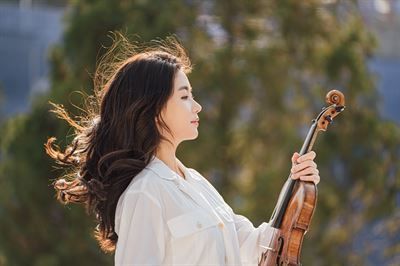
Violinist Soojin Han / Courtesy of Credia
By Soojin Han
Music is an integral part of the history of humankind.
It has served as an emotional outlet, a source of solace, a symbol of solidarity and in many cultures, an essential part of education.
The ancient Greek philosophers believed that music had a powerful influence on moral guidance with good harmony and rhythm aiding the development of a virtuous disposition and soul, and could also serve as a healing medium comparable to medicine.
Biblical accounts attest to the healing powers of music as in the example of David's musical ability to soothe Saul's spells of agitation.
So what exactly can classical music contribute to society?
I remember two episodes while growing up in the UK that exemplify the unifying power of classical music.
The first was when I was around 5 or 6. The headmaster was a very spirited gentleman who managed to infuse the whole assembly of sleepy children with unparalleled enthusiasm while singing chorales. It was as if we all became one during that time, and that peculiarly powerful feeling of unity remains with me to this day.
The second was when in my early teens, our choir teacher handed out the music for “Locus Iste” by Bruckner. We started singing and a miracle unfolded. The harmony of the music wove a spell that bound us together in one web of heavenly warmth. It was as if we were being consecrated by the music itself, and even the most boisterous and mischievous of us came under its spell. Again, the feeling of unity was so powerful that it created a sense of awe and made us realize that we were being swept into something greater than all of us.
Unity, then, is something that classical music has to offer society. I have often likened chamber music to a microcosm of world peace. Each player contributes their own color and perspective, but always within the frame and harmony of the given piece. When one instrument has the main melody, the other parts support that voice in different ways ― never overpowering but giving leverage and creating a beautiful, living canvas for the main line to soar.
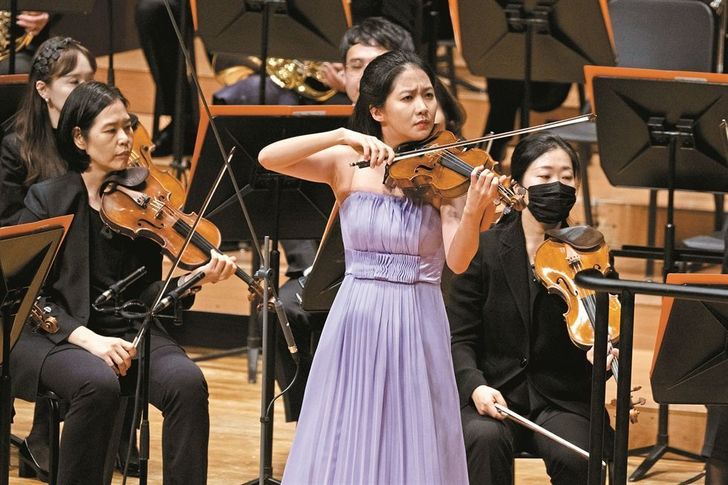
Violinist Soojin Han performs during The Korea Times' annual spring concert at Seoul Arts Center, March 23. The 18th concert, co-hosted by the paper and its sister publication the Hankook ilbo, was held to support Busan's bid for the World Expo 2030. Korea Times photo by Choi Won-suk
The benefits of music therapy are also well-known.
As an example, the director of a children's home in Busan made learning an instrument mandatory for each of the children having witnessed the positive impact music made especially on those who had been battling feelings of resentment and bitterness.
As a performer, I've been privileged to receive numerous testimonials from individuals of diverse backgrounds, testifying that listening to my performances drastically changed their outlook on life, even dissuading them from considering self-harm. They found hope and regained the will to live.
One notable example was the legendary violinist Ivry Gitlis, whose life, in his own words, had lost meaning. After listening to my performance of the Faure violin sonata, he was silent for some time, holding his head in his hands. When he finally lifted his eyes, I could see them streaming with tears. He expressed gratitude for rekindling his belief in the value of life and urged me to continue “saving the world” as a messenger.
Another powerful example involves a shopkeeper I never met, who, in the midst of the pandemic, found himself overwhelmed by lockdown restrictions, leading him to contemplate ending his life. After having closed down his shop completely and sitting by the river Han, he turned to his phone one last time.
Serendipitously, one of my performance videos began to play. Thirty minutes later, something in the music compelled him to change his mind. He reached out by commenting on the aforementioned YouTube video to express his gratitude and pledged to start anew, even promising to attend one of my concerts. These personal testimonials are just a glimpse of the profound and transformative power of music.
The potential for classical music to bring about positive change lies not only in its intrinsic qualities but also in its accessibility. It is important to break down barriers and make classical music approachable to all. Music education plays a vital role here ― by introducing young minds to classical music, we equip them with a universal language, a means to express themselves, and a source of solace. By providing opportunities to those from diverse backgrounds to engage with music, social division can be bridged and a more harmonious society cultivated.
In today's fast-paced and interconnected world, classical music offers a sanctuary ― a respite from the noise and distractions of everyday life. It encourages introspection, mindfulness, perseverance and emotional well-being. By actively listening to classical compositions, we engage in dialogue with the composer, artist and ourselves, allowing the music to unlock hidden depths in our souls. In this way, classical music becomes a transformative force, enhancing our mental and spiritual well-being.
There is a saying that world peace can be achieved through music and sports.
Perhaps it is not just the extraordinary “once in a lifetime” experience Classical music has to offer that can unite us all but the daily moments of revelation, empathy and healing that also comprise part of a longer journey to understanding humanity. And maybe it is these individual experiences that come together, creating ripples that turn into waves to change this world for the better. As Plato stated, classical music is a potent instrument that weaves its way into the innermost places of the soul. It unifies, heals, and elevates society, providing nourishment for our collective well-being.
Soojin Han is an exceptional violinist known for her expressive playing and instrumental mastery. Born in Korea and raised in the U.K., she has performed as a soloist with esteemed orchestras such as the London Symphony and Tokyo Philharmonic. She has received accolades in international competitions, including the Wieniawski International Violin Competition. In addition, she serves as a cultural representative for the Ministry of Foreign Affairs, holding key positions on the Board of Advisors for Cultural Exchange and the Preparatory Committee of the Pacific Islands Summit.