Ulsan Art Museum: 21st-century media art museum finds home in industrial port city

Nam June Paik's 10-meter-long installation, "Turtle" (1993), is on view at the Daewangam Park as part of the Ulsan Art Museum's series of inaugural exhibitions in the southeastern industrial city. Courtesy of the Ulsan Art Museum
By Park Han-sol
ULSAN ― It was the year 1993 when the video art visionary Nam June Paik first showcased “Turtle” in Germany ― his own monumental tribute to Joseon-era Admiral Yi Sun-shin (1545-98), who was renowned for successfully employing turtle ships in his naval strategies against Japanese invaders.
Nearly three decades since its inception, the 10-meter-long video sculpture, composed of 166 vintage television monitors, now emits Paik's iconic phantasmagoric collages of electronic images at the seaside Daewangam Park in the southeastern port city of Ulsan, as part of the permanent collection of the newly opened Ulsan Art Museum.
In a way, Ulsan couldn't have been a more fitting home for the piece, as the city's Ulju County is known for housing one of the world's oldest petroglyphs showing the prehistoric origins of whaling in Bangudae, a rock formation named after its shape resembling a turtle's back.
Along with Paik's two other representative installations ― “Sistine Chapel,” a dizzying, overlapping projection of images onto the gallery's walls and ceiling that earned the Golden Lion prize at the 1993 Venice Biennale and “Forest of Cage, Revelation of the Forest,” a nod to post-war avant-garde composer John Cage ― “Turtle” has become the centerpiece of the country's first public art museum that is striving to become a “museum of the future” with its media art focus.

Ulsan Art Museum Director Suh Jin-suk / Courtesy of the Ulsan Art Museum
“Ulsan's identity, both historical and contemporary, fits well with our aim to serve as a 'glocal' museum of the future that seeks harmony between ecology and technology,” museum director Suh Jin-suk told The Korea Times during a recent press tour of the gallery.
Historically, the eighth-largest city of Korea served as an important, strategic port during the Unified Silla period (668-935), where it saw rich cultural exchange between different parts of Asia, Persia and even the Roman Empire. While in modern Korea, it has been known as one of the country's industrial powerhouses, marked by Hyundai Motor's largest automobile manufacturing plant and Hyundai Heavy Industries' biggest shipyard in the world, its gradual transition to green growth and eco-friendly technologies has also been worthy of attention.
Considering such a dynamic, flexible regional identity, Suh said that Ulsan was an ideal blank slate for the Ulsan Art Museum to try out its new role as a digital, media art-centric institution that can cater to both local and global audiences.
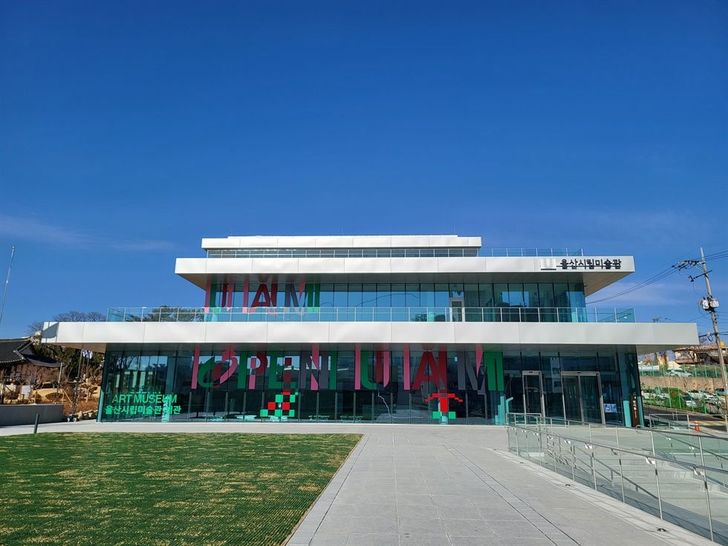
The facade of the newly opened Ulsan Art Museum / Courtesy of Ulsan Art Museum
“During the Age of Enlightenment, museums' functions were set by institutions like the Louvre and the British Museum. This was followed by Aestheticism [and Formalism], which created a demand for 'white-cube' [gallery] environments like the Guggenheim and the MoMA,” he stated. “But in the contemporary digital era, museums ― such as the ZKM Center for Art and Media Karlsruhe and the idea of the 'participatory museum' set forth by designer Nina Simon ― have been seeking a new, alternative shift in their roles.”
This is where Ulsan Art Museum's mission to provide the physical platform and hardware to showcase cutting-edge, forward-thinking works of art comes in, materialized by its five inaugural exhibitions. So far, its ambitious goal has been met with a positive response, with the number of visitors reaching more than 32,000 in the mere three weeks since its opening on Jan. 6.
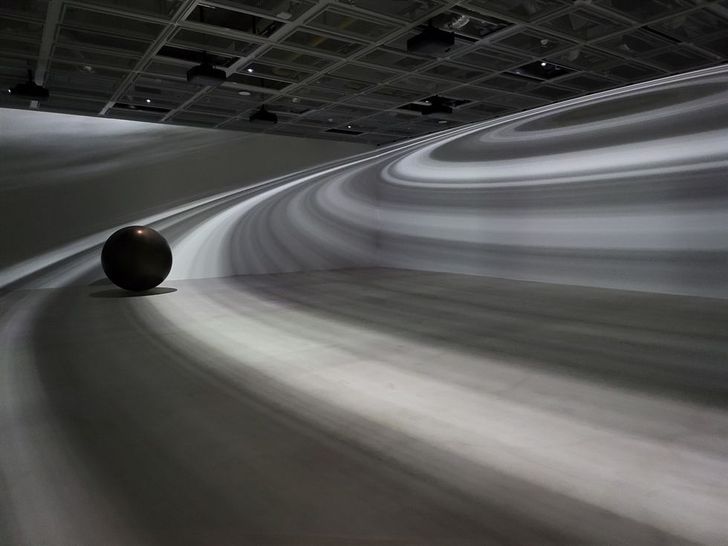
The immersive video, "We are the Primitives of a New Era" (2020), by Italian-American artist Aldo Tambellini is on display in the Ulsan Art Museum's XR Lab. Courtesy of the Ulsan Art Museum
The exhibition, “Black and Light: Aldo Tambellini,” is on view at the XR (extended reality) Lab. The lab is the first of its kind in a public museum in Korea, and is dedicated to immersive media art experiences created from digital technologies, including virtual reality, mixed reality and augmented reality.
“Equipped with 24 projectors and a fourth-dimensional sound system, it's a space that will primarily be dedicated to commissioned XR-related works born from the collaboration of artists, technicians, engineers and theorists,” Suh said.
The ongoing show features the rendered video of “We are the Primitives of a New Era” by Italian-American artist Aldo Tambellini, which became the last work of the late pioneer of “electromedia” before his death last year. His artistic practice, based on the tonal polarities of black and white, to visualize a mystical cycle of energy, fills the entire gallery space.
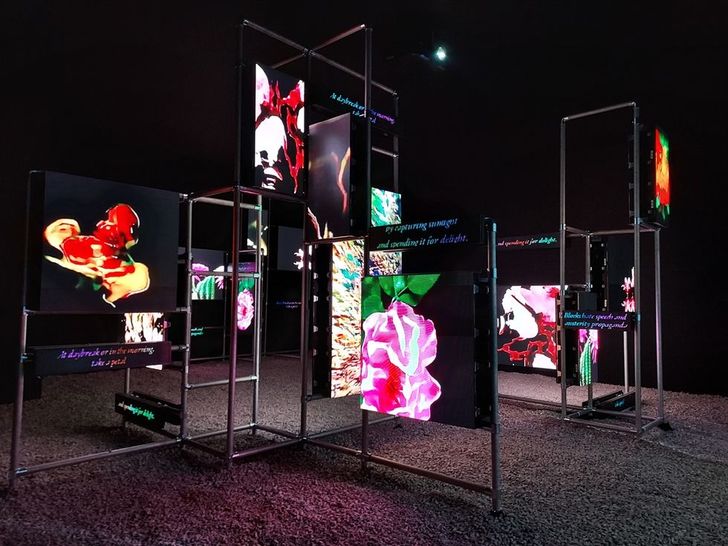
Hito Steyerl's "This is the Future" (2019) / Courtesy of the Ulsan Art Museum
The main exhibition, titled “Post Nature: Dear Nature,” imagines the future of a hybrid ecosystem where humans and non-human players co-exist ― not simply in conflict or in solidarity, but as a complex mixture of both. In recent years, anthropocentric or human-centered history has begun to be questioned and rewritten, and that is a fitting theme for Ulsan as a place defined by both its pristine natural surroundings and its powerful manmade industries.
Sixteen featured artists from here and abroad include Berlin-based media artist Hito Steyerl, who topped the U.K. magazine ArtReview's annual ranking of the 100 most influential people in art in 2017.
In her “This is the Future,” which is being shown in Korea for the first time, images of digital, non-real plants of the future are rendered on nine digital screens, seemingly growing on metal scaffolding ― a symbol of current capitalist industrial society.
The names of these virtual plants are written in Latin underneath the images, with “solutions” to the negative social phenomena that have emerged in the digital era: “social media addiction therapy,” “healing of the syndrome of being silent about hate speech” and “dictator poisoning.”
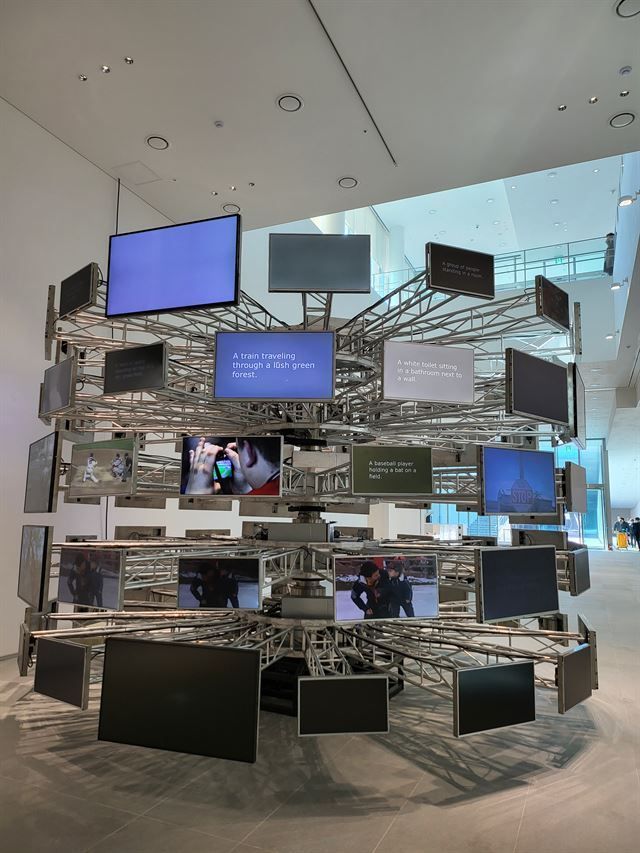
"Reverie Reset" (2016-17) by Yan Lei / Courtesy of Ulsan Art Museum
In Chinese artist Yan Lei's “Reverie Reset,” a series of 80 digital displays are revolving in a circle as a gigantic repository of information. After scanning a QR code, viewers can submit any image they would like through their phones; these images are then interpreted by an artificial algorithm according to their average pixel colors and subsequently described in quite odd, surreal human language: “A young boy is hiding a cell phone” and “A woman is holding a child in a small hat,” for example.
The museum has also unveiled its permanent collection at the show "The Brilliant Days" at Daewangam Park.
On display are contemporary masterpieces like Lee Bul's “Willing To be Vulnerable ― Metalized Balloon V3” presented at the 2019 Hong Kong Art Basel Fair; “Chroma” by Kim Yun-chul, whose yearslong exploration of magnetohydrodynamics has given birth to works with hydrogel-filled tubes that show the changing state of nanoparticles; Bernd Lintermann and Peter Weibel's interactive installation "YOU:R:CODE," where a row of LED screens scan viewers' bodies and "convert" them to digital data as a collage of social media icons, genetic code and even industrial barcodes; and “Can You Hear Me?” by Indian artist Nalini Malani, known for her immersive installations exploring themes of feminism, racism and post-colonial legacies.
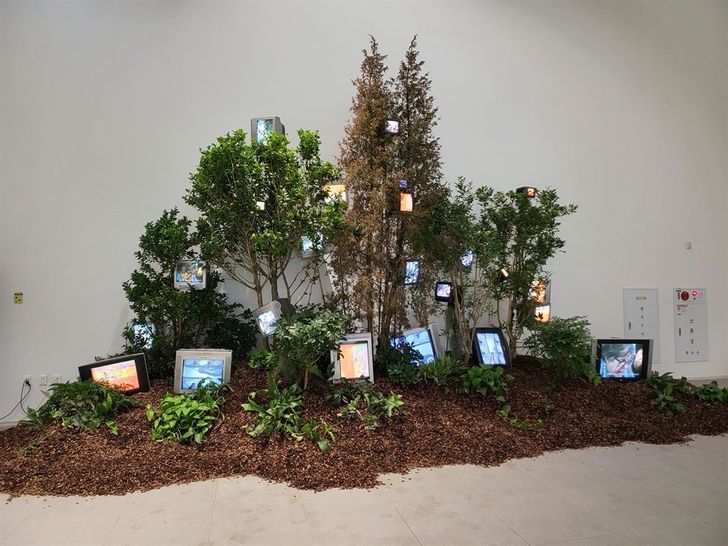
Nam June Paik's "Forest of Cage, Revelation of the Forest" (1992-94) / Courtesy of the Ulsan Art Museum