'In the past, stars were born, but now they are made'
'Big Hit Signal' author shares insider's view of K-pop industry in transition
By Park Ji-won

Yun Sun-mi, director of FirstOneEntertainment Courtesy of Yun Sun-mi
Global K-pop sensation BTS has ignited a series of debates about the group's meteoric rise in the mainstream U.S. market, which had been out of reach for K-pop bands for decades. The band members' savvy use of social media to directly interact with fans worldwide and realistic, captivating lyrics addressing universal experiences, among other things, were often mentioned as some of the key elements that made the Korean boy band roar in the global music charts.
For aspiring singers, relations with fans have become more important than ever before, making or breaking their career. The ever-growing importance of stars' interaction with fans is one of the signals that the K-pop industry has been transforming. In the past, looks mattered and stars were kept at a distance to maintain their mystique, but nowadays talent search agencies look for people with the perseverance and endurance to overcome challenges when they select their stars.
Yun Sun-mi, director of FirstOneEntertainment, is an industry expert who has witnessed how K-pop has transformed over the past decade. She has worked in the industry more than 14 years in various roles ― first as a marketer, then producer and director. In December, she released the book “Big Hit Signal,” unveiling the secrets of K-pop's global expansion with her detailed explanation of the entertainment industry.
According to the author, nowadays stars are made, not born. This signifies a shift in the rise of K-pop idols, as in the past they were able to draw attention from viewers with good looks alone and enjoyed fandoms even though they lacked other talents.

Cover image for “Big Hit Signal” written by Yun Sun-mi Courtesy of BlackfishBook
The book covers various issues from an insider's perspective, from casting to producing, which may be helpful for those who want to work in the industry or investors who want to learn about the business structures.
Starting her career at JYP Entertainment in 2008, she has participated in discovering and training stars. Some of her projects include legendary girl group Wonder Girls, boy bands 2PM and 2AM, four-member girl band Miss A, soloist Baek A-yeon, N.Flying, SF9 and Cherry Bullet. She is currently working as chief director at FirstOneEntertainment, an agency for singers Na Yoon-kwon, Kisum and Huh Chan-mi.
Yun says one of the things that touched overseas fans' hearts is the narrative of stars who rose to stardom against all odds. Many of them start their careers as trainees. Once passing auditions to join new idol groups, they live together with their bandmates for intensive training, which she says helps them build family-like bonds. They have a single-minded goal of becoming stars which leads them to success, she says.

Yun Sun-mi, director of FirstOneEntertainment Courtesy of Yun Sun-mi
“Music was once a thing that we thought we could enjoy only by listening to it but now it becomes something to be seen, meaning that it needs certain messages to show through choreography or performances,” she said during a recent Korea Times interview. “As society has become more and more materialistic, some find it tough to keep up. Of course, stars need to sing and perform well. But fans want, in addition to quality music, to consume the stories behind their rise. For example, what kinds of sacrifices they had to make in their past to become stars today or if the band members get along with each other; things like this can give fans a deeper understanding of their stars.”
By watching idol group members who spent quite a bit of time with each other for almost a decade and building solidarity to work as a team on YouTube or other social media, Yun said, fans think they become part of the journey. “Their bond with other members built through the trainee system, which is unique in the Korean entertainment industry, excites overseas fans as many of them are not accustomed to such a collective way of life.”
Yun stresses that the definition of star has been largely changing over the years. K-pop stars are no longer as distant as stars in the sky, but they are more like “cool friends” or “my baby” who can inspire their fans, which she says is one of the key elements that differentiates K-pop stars from other stars in different countries. Also, that is one of the reasons she and many other entertainment companies consider personality when auditioning trainees because people of character have a better chance to survive and overcome tough circumstances.
“In the past, if stars were pretty or handsome, it was easier for them to rise or be spotted even if they didn't sing well,” Yun said. “But now, even talented singers with good looks find it tough to succeed. Success is not simply about looks or talent or both. In the industry, we live in an era of new normal in which no formula has become a formula. People have different preferences and there's no one-size-fits-all type of success formula.”
She talked about her stint with JYP Entertainment, one of the “Big Four” along with SM, YG and Big Hit, to highlight K-pop's relative short history in global fandom. She said JYP was in its incipient period when she joined the company.
Back then, she said there were only a few singers who eyed the Asian market for their success and no system was in place that could bring them to the global market. After a while, the entertainment companies grew and started to hire more staff in various new fields including new positions such as visual director, which hadn't existed before.
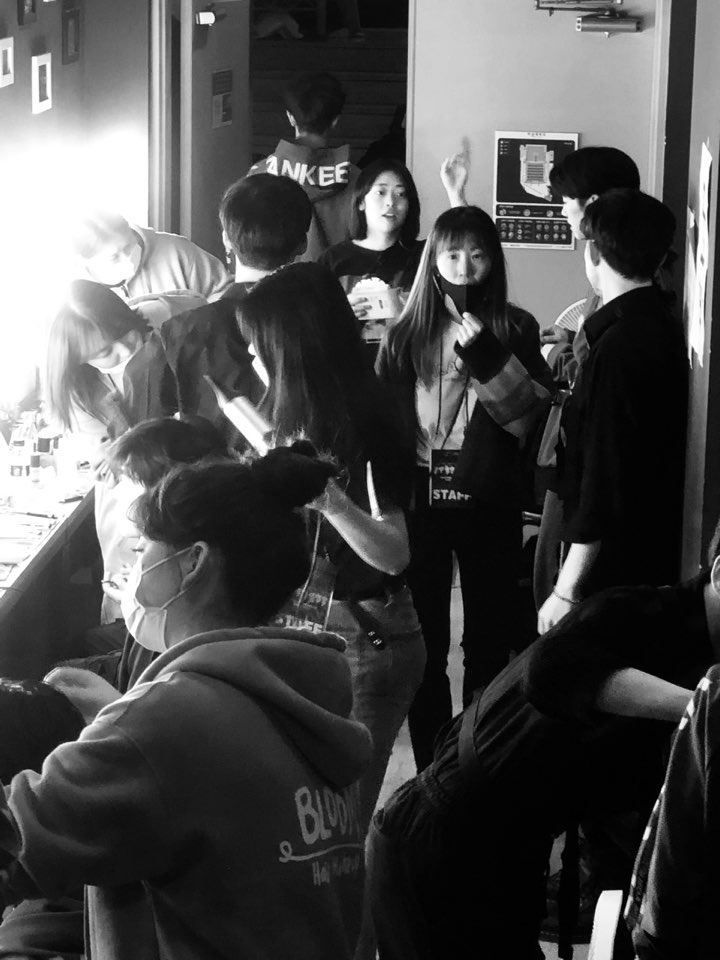
Yun Sun-mi, director of FirstOneEntertainment Courtesy of Yun Sun-mi

Yun Sun-mi, director of FirstOneEntertainment Courtesy of Yun Sun-mi
She said as the market grew, more entertainment companies also hired more foreigners to expand overseas. Being able to speak multiple languages was considered one of the key qualifications to work in the local entertainment industry. Those who didn't understand Korean still had a chance to work if they had certain key skill sets that could make them a valuable asset.
Some say around 70 K-pop groups debut each year and most of them disappear from the public eye quickly as the market is already saturated. However, she expects the K-pop industry still has enough room to grow with the emergence of the so-called fourth generation of K-pop stars seeking collaboration with anyone and using technologies from the Fourth Industrial Revolution such as artificial intelligence.
“For example, aespa, a girl group from SM Entertainment, is an example of a fourth-generation K-pop group. It does not follow the existing knowledge of idols. It has used AI and VR, technologies of the Fourth Industrial Revolution. Suga of BTS also made a virtual appearance at 2020's MAMA Awards … There are no longer boundaries between industries. BTS held hands with Samsung Electronics to promote their movies internationally. SM Entertainment also joined hands with Hyundai Motor to come up with the moving studio. I think people will see unexpected combinations of stars and industries and it will become even more common in the future.”