The old man and the bus terminal

Kim Jae-do, 81, shows Tapri Bus Terminal in Uiseong, North Gyeongsang Province, which he inherited at 17 after the sudden death of his father in 1954. He has been running the terminal for 64 years. / Korea Times photo by Jun Joon-ho
Terminal operator recalls good old days
By Park Jin-hai
Tapri Bus Terminal, a small rural terminal in Uiseong, North Gyeongsang Province, 260 kilometers from Seoul, has seen better days.
The place, once crowded with commuting students and vendors with their hands full of bottari (cloth wrappings tied into bundles) carrying grains and fruit to sell in Daegu's large Seomun Market, is now a desolate and quiet place where only a few elderly people visit.
The vintage bus terminal showing the wear and tear of time sits quietly like a granny living in a rural home who waits for a welcome visit from her grownup children who have made their own lives in the city.
Kim Jae-do, 81, who inherited control of the intercity bus terminal service at 17 after the sudden death of his father in 1954, has been running the terminal for 64 years.
“Now people as old as me mainly use this terminal. Many of them are elderly couples living with no cars, separated from their children in the cities. They use the bus to visit a general hospital in Daegu,” he said. “A lot of passengers are my longtime friends and neighbors.”
On the green chalkboard, a daily bus schedule has been handwritten neatly that shows six buses bound for nearby Chunsan and another six for Daegu. The one-way bus fares displayed in plastered paper at the ticket booth have been mostly in the range between 1,300 won and 2,000 won, with the highest price of 6,700 won reserved for Daegu bound buses.
“When the terminal was at its peak in the 1970s to 1990s, it was always crowded with people. Every day was eventful and the terminal was always filled with lively noises of students chattering with their friends, customers yelling for their tickets and scuffling with others,” Kim recalled.
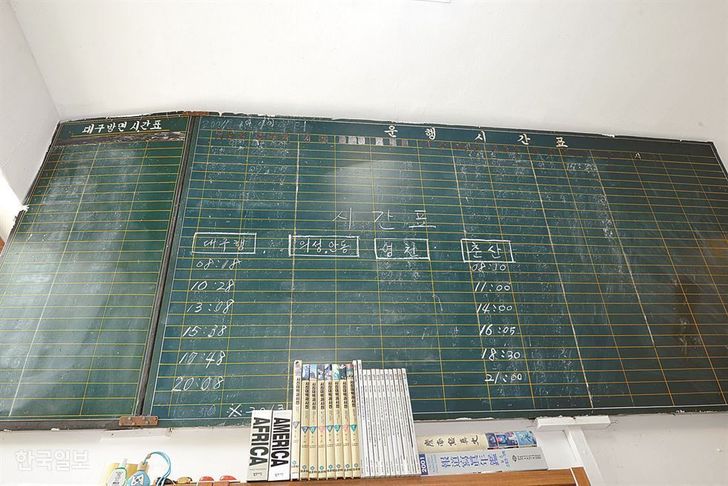
A green chalkboard shows the daily handwritten bus schedule. / Korea Times photo by Jun Joon-ho
When his business was flourishing, over 2,000 people used the terminal each day. The terminal, where 10 intercity buses used to be parked at any one time, has gone downhill fast since the early 2000s as cars became affordable to rural households. The terminal lost passengers and buses.
Now North Gyeongsang Province has designated the old terminal on a list of 20 old facilities that have been running for over 30 years in their respective businesses. The terminal has been on the list of “root businesses” of the province, along with a key repair and barber shops, a photo studio and a traditional Korean seal making store.
Due to the low number of buses using the terminal, Kim says it has become rare to see two buses in the station at the same time now. “Now we have to wait a couple hours to see the next bus in the terminal,” Kim said.
Start of family business
The precursor of the current Tapri Bus Terminal opened in 1951 during the 1950-53 Korean War. When the war showed little sign of abating, a businessman in Daegu bought a military truck that was converted into a bus. While the businessman was looking for a partner who could service the truck on the route between Tapri and Daegu, Kim's father, who had been running a small mom-and-pop store, offered to take over the job.
The town's first public transportation was able to transport 20 to 30 passengers at a time.
“At the time when my father began the service, horse-drawn carriages were still a major means of transportation. When people had to visit Daegu's big marketplace, they had to begin the journey at dawn and come back in the pitch dark, even if they took a shortcut and run the 70-kilometer route nonstop,” he said. The first bus route, detouring through small towns around Mount Palgong between Daegu and North Gyeongsang Province, took six hours ― but the bus offered passengers much more comfortable and faster travel compared with carriages. The same journey takes just an hour today.
“When we began the bus service, it carried mostly merchants like my father. My father ran the route and also bought some daily necessities like candles, matches, laundry soaps and noodles from Daegu's Seomun Market and sold them at his small store,” he said.
Kim took over his father's business in 1954, after his father suddenly passed away. Needing to take care of his mother and five siblings, as the eldest son of the family, 17-year-old Kim took on the role of breadwinner. His sister sold tickets and helped with drivers while he was at school, and he took over the job after school.
Since then, the small terminal has become Kim's life per se. “Running a terminal, I had to be ready for calls all the time. Even if I was having lunch at the ticket booth, I would have to sell the tickets whenever anyone shouts for tickets,” he said. “Then there were so many squabbles among passengers for seats, between rival bus companies' drivers, between bus conductresses and passengers and so on.”
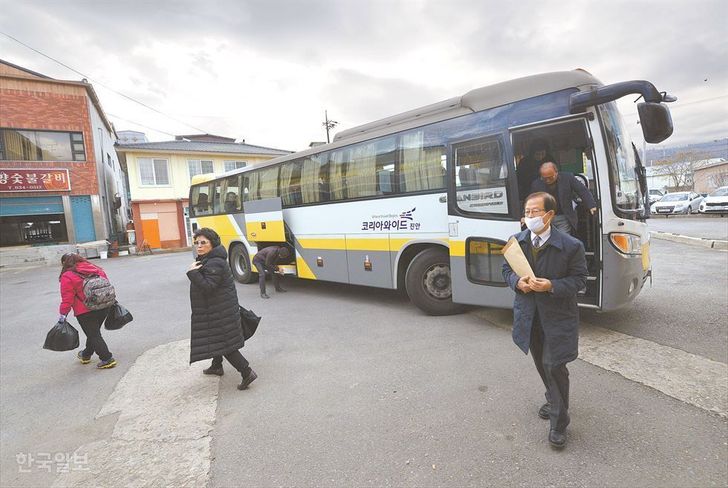
Passengers arrive at Tapri Bus Terminal in Uiseong, North Gyeongsang Province, Nov. 13. / Korea Times photo by Jun Joon-ho
With the number of buses using the terminal, Tapri Bus Terminal was registered as a public bus terminal in 1972. It moved to its current location in 1976 and expanded to accommodate 10 buses at a time in 1981. Around the terminal restaurants, cafes and pubs thrived.
Kim says he feels those days were like yesterday, when he heard the clear voice of bus conductresses shouting “alright” to signal a driver to leave. “At the time one or two buses a day carried passengers to Daegu. So buses were always jam-packed. When the old engine of the bus overheats with so many passengers on board, it breaks down. It has been a familiar scene where passengers get out of the bus and push the bus up the hillside all together or sometimes take some breaks in the middle of their journey to wait and cool down the engine. That is hard to imagine for today's generations. But then people were more laid-back and romantic, I say,” Kim said.
“During the Chuseok holidays, bus conductresses with no shoes climbed over the backs of seats to move around and collect fares in the bus jam-packed with passengers.”
Back then bus drivers received generous treatment as skilled technicians, he said. “With no driving schools, people who want to be drivers would have to work as a bus driver's assistant and help him with all his duties first to learn how to drive and repair vehicles,” Kim said.
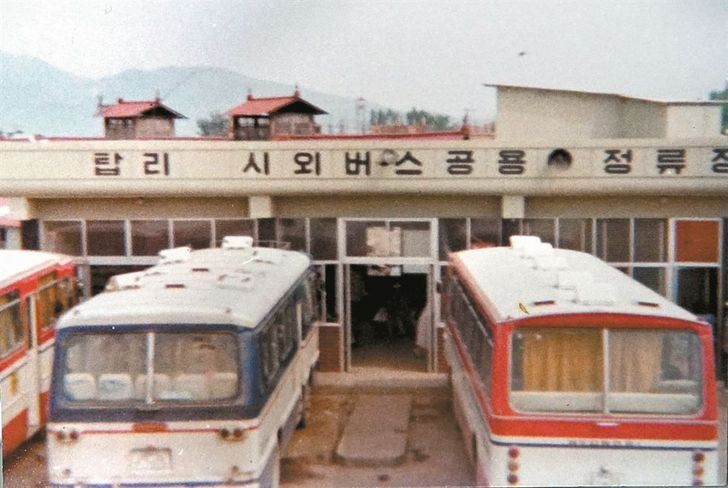
Three intercity buses are parked in Tapri Bus Terminal in this 1978 file photo. Provided by Kim Jae-do
Money-losing business
The buses carried bus conductresses, young women who collected ticket and fares and gave a signal to the driver that all passengers have boarded and the bus is ready to go, but they disappeared in the late 1980s.
Now bus drivers no longer have the same social status as they used to enjoy and the terminal has been operating at a loss for over a decade now.
“If I only cared about making profits, I would have left the business 15 years ago,” he said. With the provincial government's subsidies and small ticket sales, he barely manages to keep the terminal afloat now.
Kim said recently he received sudden notice from bus companies they would cut the bus routes by half starting Nov. 23.
With him raising the issue and the provincial government's help, the plan was nullified three days before the set date, he says. “As one born and raised here who came to work for the good of the local community for a long time, I couldn't think of my neighbors using the route. I'm living with the pride now that I'm maintaining Tapri's one and only public bus terminal that gives mobility to aged locals like me,” he said. “Most of the bus passengers are going between home and Daegu hospitals. Even if it takes some sacrifice on my part, I will run the terminal as long as I live.”
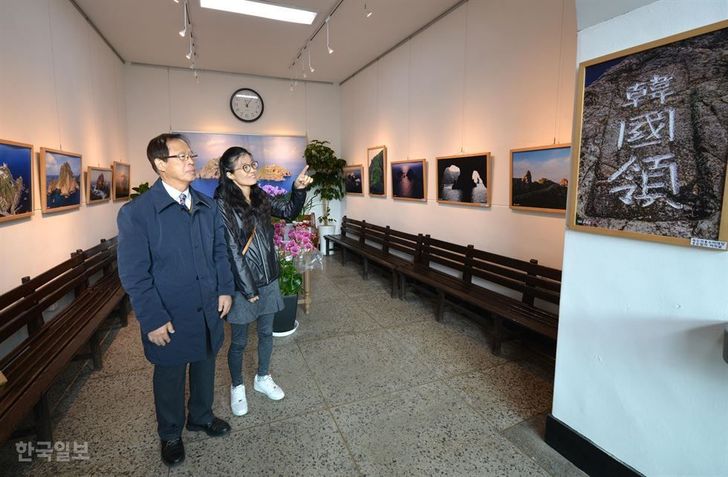
Visitors look at photos of Dokdo taken by Kim Jae-do over 11 years at a small gallery in the terminal. / Korea Times photos by Jun Joon-ho
Kim, Dokdo photographer
The waiting room of the terminal has been renovated into a small gallery. Opened in September, the gallery named after Kim displays photos of Dokdo Kim has taken over 11 years.
He says his other passion lies in photographing Dokdo, a pair of small and beautiful islets in the East Sea. Since he first happened to visit the islets in 2002, he says he has been struck by their beauty. “At that time, access to Dokdo was very limited and required permission to step on it. Riding on a helicopter, the aerial view of Dokdo made me speechless. How balanced and beautiful they were!”
Since then he has been “madly” in love with the islets and takes all possible chances to visit. “By 2013, I'd visited the place over 20 times. When the weather didn't permit, I came back after failing to land on Dokdo many times, because the ferries couldn't approach the berth.”
In order to increase the ease of visiting the islets, Kim transferred his legal docile and Dokdo became his permanent legal home. With his Dokdo photos, he has held exhibitions around the country and abroad. His photos were exhibited at the National Assembly and Korean Cultural Center in Washington in 2013.
He says Dokdo possesses a pristine beauty that most one-time visitors cannot know. “My only remaining wish is to let many others find the lesser-known beauty of the islets. Photos can speak more than just raising one's voice over the disputed islets and arranging one-time flash mob events,” Kim said. “I have so many great photos and I want to find a way to share them and let people realize the Dokdo they know is in fact just a small part of it.”